
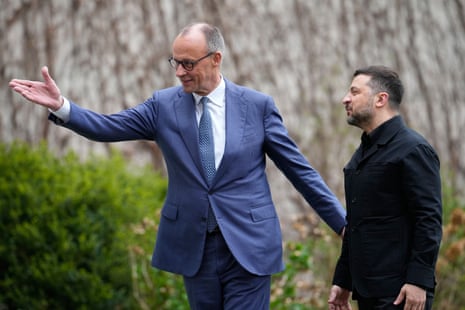
Ukraine’s president Volodymyr Zelenskyy is set to make an unexpected visit to Berlin for talks with German chancellor Friedrich Merz ahead of next week’s trilateral talks with Russia and the US in Abu Dhabi.
The rumours about Zelenskyy’s potential visit started swirling last night, with Merz confirming the visit during an industry speech this morning. The Ukrainian president’s trips are usually kept secret until the last moment for security reasons.
Recalling the infamous showdown between Zelenskyy and Trump at the White House last year, Merz said:
“He’ll be here with me just after midday, and things will be a bit different then.”
In his speech, Merz said the German push to rapidly increase its defence spending last year was triggered by the scenes in the Oval Office.
“What we experienced last year … led me to conclude that we must ensure, on our own, that we are capable of defending ourselves in Europe,” he said.
He added that this was not meant to question Nato, but strengthen it. “We are making Nato more European so it can remain transatlantic,” he said.
Elsewhere, we are expecting updates from Sweden, with a second parliamentary vote on the new government, which is expected to fail once again (51 days on from elections).
We should also get some lines from Spain, where transport minister Óscar Puente is will present new ideas on reforming high-speed rail after last week’s tragic crash in Toledo before facing a parliamentary committee.
We are also likely to see developments in Poland after last weekend’s protests over the country’s constitutional tribunal, and in Belgium amid continuing uncertainty about Bart De Wever’s government.
Lots for us to cover.
It’s Tuesday, 3 November 2026, it’s Jakub Krupa here, and this is Europe Live.
Good morning.
Before arriving in Berlin, Ukraine’s Zelenskyy condemned Russia’s overnight attacks on critical infrastructure across the country, which he said were causing “emergency and unscheduled power outages”.
He said the attacks – which involved 289 drones, 59 cruise missiles and 17 ballistic missiles – also hit civilian buildings, including a city hospital in Kharkiv, where 73 people were injured.
“A rescue operation has also been underway since yesterday in Komyshuvakha, in the Zaporizhzhia region. Tragically, the death toll has risen. Russia has killed 29 people.”
He added:
“It is very telling that all of this is happening on the day of the US congressional elections. The Russians believe that America will not notice this signal from them. But such terror must be noticed and stopped. Ukraine must be helped to defend its skies, otherwise Russia will never stop its missile strikes. It is essential to help build peace honestly and reliably, and America can do that.”
Ukraine’s president Volodymyr Zelenskyy is set to make an unexpected visit to Berlin for talks with German chancellor Friedrich Merz ahead of next week’s trilateral talks with Russia and the US in Abu Dhabi.
The rumours about Zelenskyy’s potential visit started swirling last night, with Merz confirming the visit during an industry speech this morning. The Ukrainian president’s trips are usually kept secret until the last moment for security reasons.
Recalling the infamous showdown between Zelenskyy and Trump at the White House last year, Merz said:
“He’ll be here with me just after midday, and things will be a bit different then.”
In his speech, Merz said the German push to rapidly increase its defence spending last year was triggered by the scenes in the Oval Office.
“What we experienced last year … led me to conclude that we must ensure, on our own, that we are capable of defending ourselves in Europe,” he said.
He added that this was not meant to question Nato, but strengthen it. “We are making Nato more European so it can remain transatlantic,” he said.
Elsewhere, we are expecting updates from Sweden, with a second parliamentary vote on the new government, which is expected to fail once again (51 days on from elections).
We should also get some lines from Spain, where transport minister Óscar Puente is will present new ideas on reforming high-speed rail after last week’s tragic crash in Toledo before facing a parliamentary committee.
We are also likely to see developments in Poland after last weekend’s protests over the country’s constitutional tribunal, and in Belgium amid continuing uncertainty about Bart De Wever’s government.
Lots for us to cover.
It’s Tuesday, 3 November 2026, it’s Jakub Krupa here, and this is Europe Live.
Good morning.