
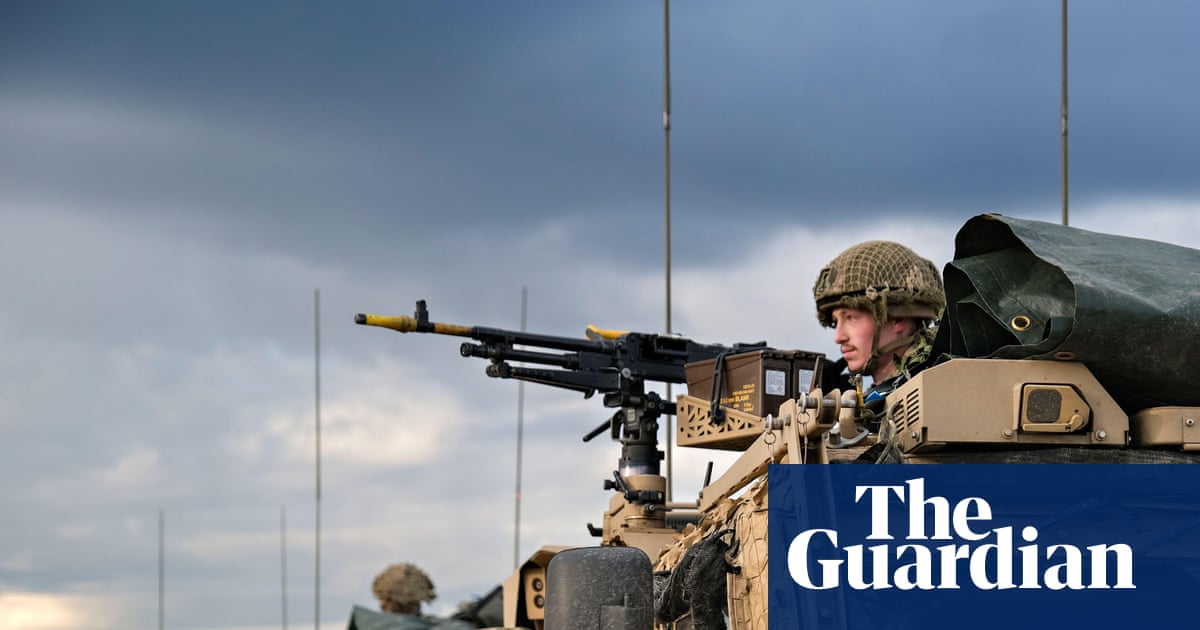
British troops and their European allies would be allowed to fire back if attacked by Russians when potentially stationed as peacekeepers in Ukraine after a ceasefire, western officials said.
The Anglo-French led stabilisation force would also not rely on US systems or technology, such as Elon Musk’s Starlink, and is expected to be almost exclusively European if deployed.
“Clearly we will protect our forces against any aggression,” an official familiar with the plans said, though they emphasised that western troops in Ukraine would engage in a manner that was “defensive in nature”.
Details emerged as the UK and France set out Exercise Koalicja, which will take place later this month in Poland. It is an 11-country rehearsal of how European militaries could deploy rapidly to Ukraine if the war comes to an end.
The test of the multinational force will involve 2,800 soldiers, sailors and aviators. France is supplying 1,500 troops from its 1st Division and Britain 300 from the 7th Light Mechanised Brigade.
Though a future deployment in support of Kyiv remains hypothetical, it is a reminder that the conflict could reignite involving British forces, given that Russia has a long history of low-level attacks during the Ukraine ceasefire between 2014 and 2022.
Lt Gen Tom Bateman, the commander of the force, said the UK, France and other European countries were committed “to providing robust and binding security guarantees for Ukraine following a cessation of hostilities”.
The purpose of the exercise, he added, was to show that the countries involved could display “military preparedness, rapid deployment capabilities and ability to operate effectively”, testing plans that have been in development for over a year.
Other countries participating are Poland, Germany, Belgium, Estonia, Lithuania, the Netherlands, Spain, Sweden and Turkey.
The British general emphasised that the force was “non-Nato” – meaning it would operate outside the western military alliance – and was expected to have little to no US support if deployed into Ukraine.
Care is being taken not to use US technology, almost certainly as a result. “We are not dependent on US systems,” one official added, when asked if the multinational force was reliant on Starlink satellites for communications.
Though the US has repeatedly sought to lead negotiations with Russia and Ukraine, President Donald Trump has said he would not commit American forces to peacekeeping in Ukraine should a durable ceasefire be agreed.
A fresh round of peace efforts this autumn have yielded little progress, however, though there are plans for three-way talks brokered by the US later this month.
Both countries have continued to bomb each other’s energy infrastructure – and on Sunday and Monday Ukraine and Russia’s air-raid alert apps were hacked. Briefly, the Ukrainian one warned of nuclear and chemical threats as well as “streetfighting”.
International concerns have emerged about the reliability of US support for allies. Last month, the US suddenly restricted Ukraine’s use of Starlink’s military variant, Starshield, for about 10 days, affecting medium-range drone missions.
A key aim of the multinational force would be to assist with “regenerating and strengthening” Ukraine’s military after a war, Bateman said, though the intention was for western troops to deploy well away from the front.
Its rules of engagement would nonetheless allow troops to defend themselves against any Russian drone attacks, raising the question of how Moscow would respond to any armed incidents. All militaries are ready to act in self-defence, though the doctrine is often expanded.
In the Middle East, the UK has committed to help a series of countries to defend themselves against attacks from Iran and Yemen’s Houthis. RAF Typhoons flew dozens of sorties from Qatar to protect Gulf states in the spring, and last month the UK committed to help Saudi Arabia deal with Houthi missile and drone strikes.
Fighter jets are also expected to help reopen Ukraine’s commercial airports with patrols and there are plans to clear mines in the Black Sea to reopen it for grain exports and other maritime trade, an operation led by Turkey.