
Maksym Bakhmatov, the outspoken head of one of Kyiv’s largest city districts, did not mince his words when it came to who was responsible for the devastating power outages plaguing his area’s 600,000 residents.
“First, because of Putin,” he said from his office in Desnianskyi, a working-class area on Kyiv’s left bank. “Second, because of lack of normal management from the mayor, [Vitali Klitschko]. That’s it.”
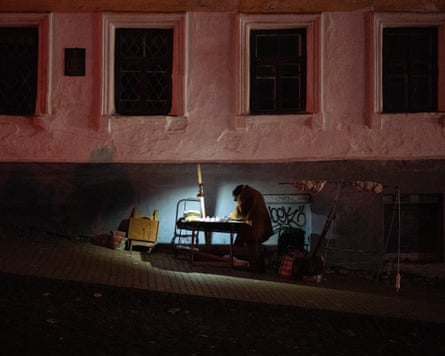
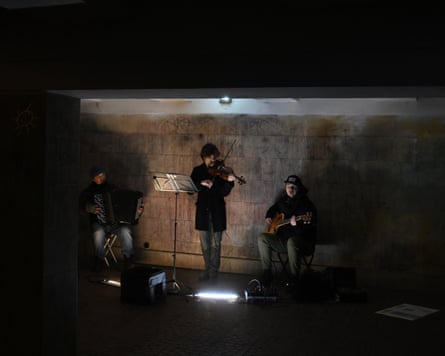
It may seem unfair to blame a wartime mayor facing daily strikes from Russian ballistic missiles and jet-powered drones for the devastating energy crisis now hitting major Ukrainian cities. Among the worst hit is Kyiv where many homes only have power for four hours a day now, well before the winter months when freezing temperatures will put far more strain on the remaining infrastructure.
This week Russia struck two crucial bridges in Kyiv crossing the Dnipro river with ballistic missiles, threatening to cut off the two sections of the city – part of a broader strategy aiming to sever the western and eastern sections of the country.
But critics argue that the city’s management failed to prepare for the dire power shortages despite clear signs the Kremlin would target Kyiv with strikes that would seek to end its viability as a livable city.
Bakhmatov said some homes had already had power outages of up to 37 hours straight. As a district head, he said he did not have the budget or financing to take on the larger projects that he believed should have been implemented over the past five years – decentralising power generation and finding workarounds to help the city survive another winter of Russian attacks.
“We have no alternative generators in order to generate electricity inside of Kyiv,” he said. “They didn’t build anything for this, and for now we have almost a collapse of city.”
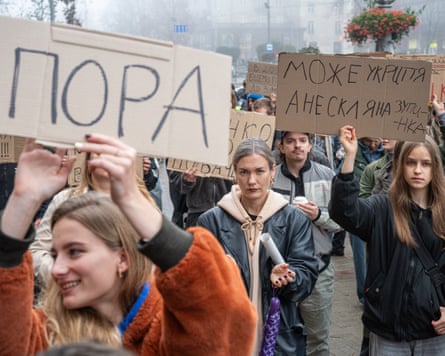
A rare wartime political rally in Kyiv last month gathered about 500 people on the downtown Khreshchatyk street to accuse Klitschko of a number of alleged shortcomings, including the energy crisis.
“Kyiv is in blackout – Klitschko will get knocked out,” read one sign at the rally, referring to the mayor’s history as a boxing champion.
More concerning than that rally may be the mounting political pressure from Ukrainian president Volodymyr Zelenskyy, who has blamed Klitschko for failing to prepare for the winter season.
“The situation is worst in Kyiv – people and businesses are facing prolonged power and water outages, and the challenges are extremely serious,” Zelenskyy wrote last week in a direct attack on Klitschko’s leadership. “In fact, these are the consequences of the failure to implement decisions at the city level on preparations for the heating season, as well as of this Russian operation against Ukraine’s energy infrastructure.”
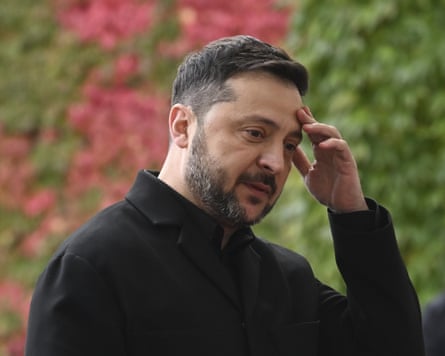
Klitschko defended himself the same day, asking “How is [Kyiv]… supposed to stop the Russian special operation against the Ukrainian energy system?”
The Guardian has previously reported on intercepted Russian plans to make Kyiv uninhabitable, prescribing strikes with specific drones on power plants and substations that could cut off electricity, heating, water, and even sewage systems, causing the “deterioration of sanitary conditions and the forced outflow of residents from cities.”
Ukraine’s central government is responsible for the defence of most large power plants and other energy infrastructure and the country’s centralised grid means that it is also responsible for trying to keep the lights on and water running in cities around the country.
“The mantra of the central government that Kyiv is the worst, its constant manipulations and lies are a bad story,” Klitschko wrote. “Because in its attempts to get rid of Klitschko by any means necessary … the central government is in fact destroying Kyiv.”
Volodymyr Fesenko, a veteran political analyst, said the “conflict between Zelenskyy and Klitschko is very old and very personal”. It goes back to when Zelenskyy was a standup comic skewering Ukrainian elites, including Klitschko, and continued after he became president in 2019. The two are not known to have met in person since Zelenskyy became president.
“The city really is not ready as compared with other cities, say, Kharkiv,” Fesenko said, noting the lack of follow-through on promises by the Kyiv government including the construction of more bomb shelters. But the central government also answers for the defence of large infrastructure, including bridges, he added. And then there was Putin, he added, who it appeared had “made a conscious decision to try to break us”.
It would be difficult to remove Klitschko as mayor but Zelenskyy’s office had in the past mulled removing Klitschko’s authority over much of the city’s infrastructure, he said. It was not clear if those plans were moving forward at present, and whether Zelenskyy would want to risk further political chaos in an already tense situation.
“There is a risk to Klitschko right now. We will see if Zelenskyy ultimately moves forward with efforts to remove him, but it is probably not Ukraine’s biggest political issue right now,” Fesenko said.
Demonstrators at the rally last month noted that they didn’t want their protest to be construed as helping Russia undermine the political stability in Ukraine. But the anger at Klitschko was on full display. “We’ve learned in Ukraine that changes usually only come when the fire starts,” said one protester with dyed red hair and a long blue coat, who gave her name as Maryana. When asked what she meant by fire, she answered: “Molotov [cocktails].”
Kharkiv, which is about five hours east of Kyiv by car, sits just 19 miles (30km) from the Russian border. In an interview in Kharkiv, the mayor, Ihor Terekhov, said the city faced an even more dire threat than Kyiv and other Ukrainian cities from Russian missiles and cited a “catastrophic” shortage of funding for the efforts to heat the city.
“We have set out on a path to decentralise the system that provides utility services, as well as energy services,” he said.
That would involve taking Kharkiv off the grid by creating “energy islands” – small, fuel-powered generators that can provide electricity for essential services, as well as modular boilers and other workarounds, he said. “It is very costly and time-consuming.”
In Kyiv, Bakhmatov’s office was dark as he spoke. It was adorned with a wall-sized map of his district and plenty of anti-Klitschko posters. He was openly partisan against the current mayor and even said he himself may be a reasonable replacement.
But he said he was most interested in representing the people of his district. Its population of 600,000, he said, would make it one of the largest cities in Ukraine on its own, and there was no workable evacuation plan for local residents. They would need to find a way to live out a cold, dark winter there.
“We need help with the generators, with food, with power stations, and so on,” he said. “Just help us.”