
Ukraine: ‘I was lucky not to die. I had guitars with me on the frontline’
Andriy Zholob, vocalist/guitarist, Beton: When MTV arrived in Ukraine, I heard Nirvana, the Offspring, Bad Brains, Social Distortion and thrash metal, and realised that all this started from punk rock. Our drummer and I were in a ska-punk band first, but when our vocalist became pregnant we started Beton in 2017 and played lots of festivals.
Everything changed with the invasion. In 2022, I started military service as a surgeon on the frontline. We were attacked many times and on at least four occasions I was lucky not to die. I had guitars with me on the frontline and every evening we’d play just to relax. At one point, my commander gave me eight days off to record a battle song for our brigade and Beton did a cover of the Clash’s London Calling – Kyiv Calling – to raise money for the Ukrainian resistance. I wanted to use punk rock to stand against evil.
I finished my service two years ago, quit medicine and now work with veterans, many of whom come to our gigs. There are guys and girls with prosthetics, slam dancing, singing along and everything. It’s a real moment of punk rock unity. We play two or three shows every month, but I like to spend time in the mountains. Although I play punk rock, sometimes I need silence.
Morocco and Spain: ‘People would tell me: you love Satan’
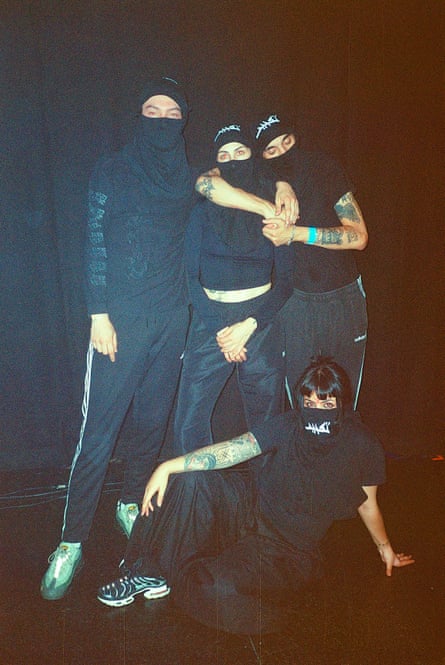
Nao, vocalist, Taqbir: In the Muslim community of Morocco, where I come from, the punk look is not accepted. For a long time, I had to perform anonymously, with my face covered, in case people recognised me and wanted to hurt me. Being a punk is not for the faint-hearted. Even in Spain, where I live now, I felt isolated as an immigrant and as a woman who did crazy things to my hair. People would tell me: “You love Satan.”
I heard Crass when I was 13. They were the first band I heard where I recognised myself in the lyrics, because I felt oppressed by religion. Then through chatting with friends online, I discovered more. I’d go to shows in Madrid, take off my hijab and wear makeup. It was a double life that meant I finally felt free to be myself, but for a long time punk cost me my relationship with my family.
Being in Taqbir really helped. I was very angry, so fronting the band was like a cure for this rage. People seem to connect with the rawness. We’ve played in north Africa and the UK and my dream is to be able one day to play in Morocco. Punk has helped me see that things don’t have to be black and white: people can be punk and Muslim and gay. Although there’s anger, our message is positive. If you’re feeling oppressed or that you cannot be yourself in this society, Taqbir are for you.
South Africa: ‘Being from Soweto automatically makes you political’
Abdula Skink, vocalist, Twenty One Children: A lot of kids in Johannesburg got into punk because there were no jobs or infrastructure for us. I grew up in a hip-hop house, but found bands such as Suicidal Tendencies and Black Flag through video games and older friends who skated. Punk just flicked all these switches in my head. Our guitarist, Thula, used to play in TCIYF, the first all-black punk band in South Africa. When we started our band in 2023, I was an assistant teacher for 21 autistic kids, so that became our name. I was also 21, so it felt like a lucky number.
Being from Soweto automatically makes you political. All the great revolutionaries – Hugh Masekela, Nobel prize winners, Desmond Tutu and so on – came from here. Our motto is: if something isn’t true, we won’t sing about it. Our song Scab is about a time I was stopped by police because I was skating through a historically Afrikaans/white area. I had green hair and the policeman was like: “You’re on drugs.” He ripped my Suicidal Tendencies T-shirt, dropped my laptop from my bag on the street and tried to take my skateboard. I wasn’t doing anything illegal. They were just fucking with me. Mostly, we try to make a difference in our communities. Thula built the first DIY skate park in Soweto; we’ve done charity shows for orphanages and such. For us, punk is not so much a livelihood but a way of life.
India: ‘We were bombarded with threatening messages’
Aditya Naik, vocalist/guitarist, Punk on Toast: I grew up listening to Bad Religion, NOFX, the Sex Pistols and the Clash and saw a satirical commentary about our times, so I started the band when I was 17 so I could talk about what was happening around us. In India, you see cruelty or injustice on every corner, so we don’t relate to mainstream music, which ignores this.
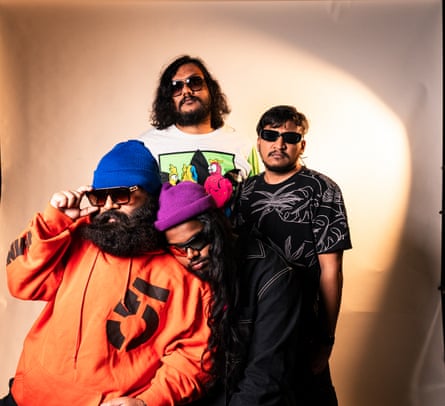
At the moment, there’s a lot of oppression of artists. After our song Modified talked about what the right wing are trying to do with us, we were bombarded with threatening messages online. People went through all our profiles, trying to find our phone numbers, where we live, our employers. It felt like being molested. Although we’ve had coverage in Rolling Stone India, the punk scene mostly flies under the radar, but that means we’re freer to sing about what we want.
We took part in the recent Cockroach protests in Mumbai, which alerted people to how things are and got everybody out on the street. Before that, India felt like a small elite club where everyone else is the “cockroaches”, so it was like seeing a phoenix: hope. The punk scene is growing, with our friends Pacifist and Emergency Trigger and bands such as the Light Years Explode and the Riot Peddlers. It’s more about documenting our times and standing for what’s right rather than selling lots of records, but punk rock gave me the greatest superpower: question everything.
Brazil: ‘Under a military dictatorship, there were kids brave enough to play with passion and fury’
Henrike Baliu, vocalist, Blind Pigs and Armada: When the original UK punk explosion happened in 1977, my dad was a naval engineer stationed in Southampton. He saw the Boomtown Rats performing Lookin’ After No 1 on Top of the Pops and told the guy in the record shop: “Give me everything you’ve got” – which meant the Sex Pistols, Generation X and so on.
Years later, when I was 12, I played some of my dad’s records to my friends and they told me about the punk scene in Brazil. Bands such as Ratos de Porão, Inocentes and Cólera sang about life under a military dictatorship, which Brazil was in the 80s. People were disappearing or being murdered, so it blows my mind that under a dictatorship with virtually zero news, poverty and police brutality there were kids with spiky hair brave enough to wear fake leather jackets and play with passion and fury. Those bands were pioneers who paved the way for us.
Blind Pigs were probably the biggest punk band in Brazil over the last 30 years, but now I’m focused on Armada. We are bilingual and sing in Portuguese and English. When we recorded our English language album, Tales of Treason, the country was going through another crazy time politically and the right wing were on the rise again. With the music, I wanted to warn people to learn from history: “Dudes, you don’t want that again.”
Latvia: ‘On stage I let out all my anger’
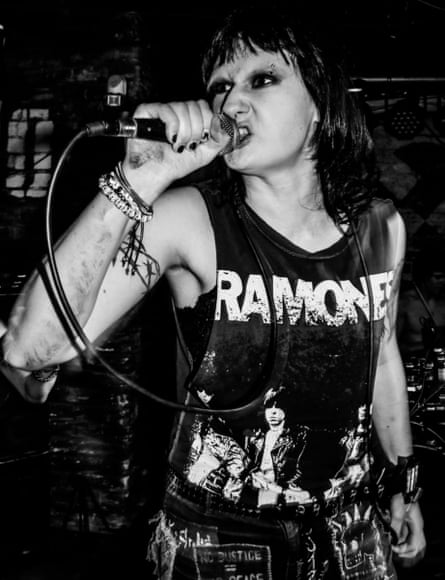
Evisa Petrovka, vocalist, Depustūtes: In high school, I didn’t really like pop, so I got into metal, but I felt it was missing lyrical depth, so punk really resonated. Ramones and the Sex Pistols sang about the same stuff that made me mad or frustrated. The Dead Kennedys’ political commentary really connected and then I discovered riot grrrl. As I got older, I realised there was a punk scene here in Riga and a whole community of people like me.
There’s so much going on in the world – I’ll never run out of topics and writing and singing in the band never gets boring. On stage, I let out all my anger. Whether I’m running or crawling on the floor, it’s just pure emotion. Singing in Latvian makes it easier to sing about local politics. Lately, we’ve been addressing how people who actually benefit society aren’t getting paid as well as those who aren’t, but I sing about societal norms and stereotyping.
Our song Mrs Pieklājība (Mrs Polite) starts, in a mocking way: “I love listening to men and being obedient.” It was inspired by people telling me “you should smile more” or “women don’t dress like that”. There’s always been at least two women in the band, but most people are really supportive. I love inspiring other girls’ lives. A lot of them come up after shows and say: “That was so inspiring. I wish I could speak as freely as you.”
China: ‘Our albums were confiscated and our work was taken offline’
Wu Wei, vocalist, SMZB: Wuhan and Beijing were the first cities in China to have punk music. I founded the first punk band in Wuhan in 1996 after falling in love with tapes that my friends sent me from the US – initially the Sex Pistols, the Clash, Ramones and then bands with other styles, such as US Bombs, Suicide Machine and Rancid. Through punk, I finally found a way to express myself. Although the scene is still quite small, we were one of the first bands to go on national tours, which influenced the development of punk in other cities. We sing about the environment we operate in: political aspects and things I’ve witnessed in daily life under the system in China.
A few years ago, the authorities prohibited us from performing. Some albums were confiscated, our work was taken offline and our record company was forced to terminate our contract. Despite this, our audiences have a wide age span and range from other punks and bands to art workers, students and ordinary wage-earners. Punk has brought me so many things, from running the bar Wuhan Prison to my personal life. I’ve now settled in the UK with my family, but frequently return to Wuhan for rehearsals and recording. SMZB just released a bilingual album, When the Party Is Over, for our 30th anniversary. Punk has given me my life.
Greenland: ‘I’m 38, a father, still have my piercings and still consider myself a punk’
Jenseeraq Olsen, vocalist/guitarist, Uummat: We have a running joke with Iceland that they are green and we are ice, so most people live on the coast. I was in Denmark for a festival recently and realised that there were more people there – 70,000 – than the entire Greenlandic population. Punk is very much a minority interest here, but I was always rebellious when I was young and didn’t like the mainstream pop my friends were into.
After I saw an advert for Blink-182’s Enema of the State album after the movie American Pie, I realised they were the band I’d been searching for. I was teased for having multicoloured hair and ripped clothes, but Blink were a big influence on Uummat, which means “heart”. We were different from other bands in Greenland and people connected with it: we’ve played to 2,000 people.
I’ve never really written political songs, but Trump’s threat to annex Greenland has made a lot of people emotional, stressed and nervous, which I’m sure will come out in the music. I’m 38, a father and manage a youth centre now, but Blink resonate as much as they did when I was 15. I still have my piercings and I still consider myself a punk. Meanwhile, my 11-year-old son listens to the same music and plays guitar like me. He thinks labels like “punk” are for adults, but he likes the word, so he’ll probably follow in my footsteps.