
Good morning and welcome to our Europe live blog, I’m Frances Mao.
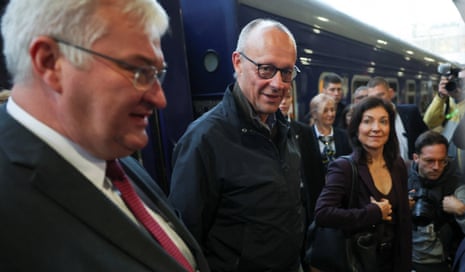
We begin in Kyiv where one of Ukraine’s strongest European backers, the German chancellor Friedrich Merz, has arrived this morning in an unannounced visit.
Soon after his arrival, the Russians struck the city’s North Bridge, just a 20-minutes drive from the central railway station where Merz had pulled into.
Sirens have rung out across the city and smoke can still be seen rising from the Dnieper River bridge. Yesterday, Russian drones also struck another bridge, causing injuries; the Kremlin has stepped up attacks on the capital this year and Ukrainians say they are steeling for another autumn blitz ahead of a tough winter.
“Ukraine is facing decisive weeks. That is why I travelled to Kyiv today with the message: you can rely on us,” Merz has written on X. He’s brought several German defence manufacturers with him and is expected to meet with Zelenskyy.
Elsewhere across the continent today, Bosnians are voting in a national election likely to determine the course of their strained EU accension path so far.
And I’ll also bring you an update on the rent protests we saw across Spain’s largest cities yesterday.
This is the German chancellor’s second visit to Ukraine during his 18 months in office so far.
Merz is facing significant domestic pressure back home with record-low ratings and major losses against his party in three recent regional elections.
But along with the leaders of France, the UK and Poland, with whom he last travelled to Ukraine in May 2025, he has been among the most staunch of Ukraine supporters and has pushed to increase aid as well as work on defence co-operation with Zelenskyy’s government.
He is expected to announce in his visit today the release of €1 billion in military aid and €350 million for repairs in Ukraine’s energy sector – the sites of which have been heavily targeted by Russian strikes and need to be restored going into winter.
He is also expected to finalise a deal for drone production between German and Ukrainian manufacturers. He’s been accompanied by several German CEOs including from Siemens Energy, Hensoldt, Diehl Defence, Quantum Systems and other firms as well as his Economic Affairs Minister Katherina Reiche.
In his X post this morning he’d repeated the pledge “You can count on us” adding: “Germany’s security also depends on the outcome of this war. That is why we are helping out of our own self-interest as well.”
Earlier this week, Zelenskyy had also said that Ukraine would close a deal soon on the joint production of drones, missiles and their software with Germany.
Merz has met Ukraine’s President Voldymyr Zelenskyy at the main war memorial on the Maidan in Kyiv.
Both men lay tributes at the central site, which features thousands of Ukrainian flags and framed portraits of the soldiers who’ve been killed in the war that’s gone on for more than four-and-a-half years.
Some pictures from the scene just now:
The North Bridge – one of several connecting central historic Kyiv to the residential suburbs across the Dnipro river -was struck not long after the German chancellor’s arrival in the Ukrainian capital.
The incident has been confirmed by Kyiv’s mayor Vitali Klitschko this morning who wrote on Telegram: “Impact on the road surface of the Northern Bridge. Emergency services are heading to the scene.”
There’s no word of casualties yet. Pictures and footage being shared online appears to show a missile slamming into the cable bridge and the resulting fireball explosion.
It follows strikes by the Russians on the South Bridge on Friday and Saturday, and several earlier this week that had shut three of the city’s six road bridges over the Dnipro.
Merz has arrived in the thick of it, as Kyiv, which was largely spared direct aerial strikes in the first years of the war has increasingly come under attack since April.
The Russians have launched strikes day and night, hitting schools, petrol strations, government buildings and churches as well as rails and communication infrastructure.
Good morning and welcome to our Europe live blog, I’m Frances Mao.
We begin in Kyiv where one of Ukraine’s strongest European backers, the German chancellor Friedrich Merz, has arrived this morning in an unannounced visit.
Soon after his arrival, the Russians struck the city’s North Bridge, just a 20-minutes drive from the central railway station where Merz had pulled into.
Sirens have rung out across the city and smoke can still be seen rising from the Dnieper River bridge. Yesterday, Russian drones also struck another bridge, causing injuries; the Kremlin has stepped up attacks on the capital this year and Ukrainians say they are steeling for another autumn blitz ahead of a tough winter.
“Ukraine is facing decisive weeks. That is why I travelled to Kyiv today with the message: you can rely on us,” Merz has written on X. He’s brought several German defence manufacturers with him and is expected to meet with Zelenskyy.
Elsewhere across the continent today, Bosnians are voting in a national election likely to determine the course of their strained EU accension path so far.
And I’ll also bring you an update on the rent protests we saw across Spain’s largest cities yesterday.