
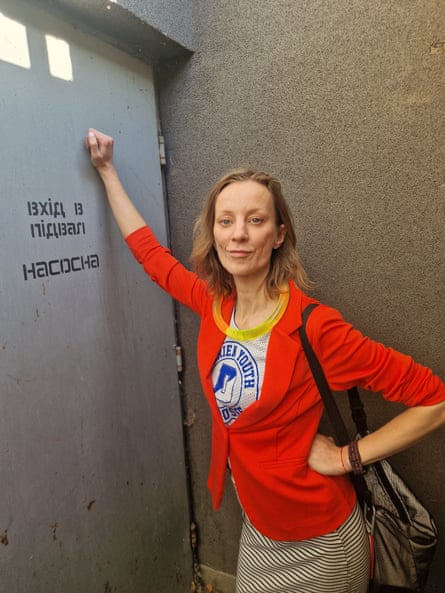
I was standing in front of a locked basement door in a building in our neighbourhood, laughing, as Ukrainian air defence shot down drones directly above me. I had run into the first residential building I could reach, and I even took a photo of the locked door – a shelter, and the shelter locked – because I wanted to remember it. I was on my way to buy curtains.
I hadn’t checked whether there was an alert before I left home. I had simply set out for the shop, 20 minutes away through our residential district, on foot. But somewhere along the way, things started exploding in the sky above me – and I was suddenly walking through a city under attack because I had decided that my windows needed new curtains. What the fuck was I laughing at? I should have been terrified, and I was. It was just that I still wanted the curtains, and the absurdity was hilarious.
The curtain shop was closed because of the raid – this international chain, it turns out, shuts when the sirens go off, unlike many Ukrainian-owned stores. So I came back the next day and bought them. They are better than the old ones and cover the windows properly. Only after I had hung them did I realise that they also let me see less of the war from my sofa: the flashes of air defence, the smoke, whatever was happening outside. I had not made the war any safer. I had only made it slightly harder to see.
I had been away from Kyiv for a month and while I was gone, the rhythm of the war, which I have lived with for years, had changed: attacks now came by day, alerts could swallow half of it, and explosions, drones and smoke had become part of the daytime soundscape in a way that felt new even to me. My response, apparently, was to buy curtains.
In January 2022, back in Mariupol, when everyone around us was waiting for Russia to invade, my husband bought an expensive coffee machine. I thought it was ridiculous. He told me he was tired of living in fear and anticipation, that he wanted to live here and now, and that if the machine survived only a couple of weeks he didn’t care. Since the full-scale invasion, he has bought a television, an electronic piano, a huge monitor for my laptop, a washing machine and a dryer – every year something large that could be smashed in a second.
We don’t do the big things. Our flooring still needs repairing, and the flat we have lived in since we fled Mariupol in 2022 needs renovation. We don’t invest in it because spending serious money, time and energy on a place a missile could destroy tomorrow feels slightly insane. There is a strange logic in this, a logic that isn’t really there when I look at it closely. But the small things keep sneaking in.
I left all my books in Mariupol. When we fled, they were not exactly high on the evacuation priority list, and later they were lost when our rented flat was destroyed in the airstrike on the Drama Theatre. I started buying books again in Kyiv, one at a time, and somehow I now have a bookcase full of them. We got plants. We got cats – four now, two from Mariupol and two adopted during the full-scale war. One of them can barely see, barely hear and limps after an accident; we chose him in 2023, apparently deciding that what our lives really needed was another vulnerable creature to worry about.
The rational wartime strategy would be to own less, need less, attach yourself to less. We have left home twice, both times with only what we could carry, so nobody needs to explain to us what attachment costs.
It isn’t that we don’t know what can happen. Last week a building belonging to my husband’s workplace was hit. He was in a different one, but he could have been there, and I don’t know how to convey that fear. I keep my Instagram mostly to cats, standup, sport, beauty and interiors, because I don’t want to spend every waking hour looking at war – but the news gets through even those filters.
In my feed I saw a post from a soldier at the front, showing footage from the site of that building: the car park, the burnt-out cars, and the news that his wife, who had worked with my husband, had been killed there. There were photographs of the two of them walking into the new house they had bought and planned to renovate, the walls still bare, the new car they had bought 10 days earlier – and then that same car, gutted in the car park along with everything around it. She had been inside. It was one and the same strike. What is there to say?
During an attack, we have our own little scale of urgency. Ballistic missile: bathroom. Now. Cruise missile: you can finish your coffee. Drones take the longest, so you can usually carry on. For now.
In fact, I am writing this column from the bathroom, the safest place in the flat. There is an air-raid alert and I can hear air defence outside; the four cats are with me. On Telegram, people post live videos from all over Kyiv, often before anything appears in the official news, and as I write this, Ukraine’s National Academy of Sciences building in central Kyiv is on fire. One person has been killed. People are climbing out of upper-floor windows on to fire ladders. I am sitting in the bathtub, watching it live on my phone and writing about curtains.
During another alert that lasted through the afternoon and into the night, we visited friends for a Sunday barbecue. We sat outside while something was burning or being intercepted somewhere above us; meanwhile, someone turned meat on the grill and my friend’s mum told me about the new flowers in her garden. At some point I had the very clear thought that, theoretically, something could fall straight on to my plate. Then I looked back at the flowers.
This is what I find difficult about the word “resilience”, so often used about people living in war zones. It sounds like a virtue, something noble you develop when tested – but it feels much less noble than that. The curtains hide a little of the war from me. I feel guilty for shutting my eyes to the horror outside, but in reality it’s more like refusing to allow the war to make every decision.
So the curtains are hanging now. They make the room warmer and they cover the windows better. The photo of the locked door is still on my phone. Next: I need to paint the walls in the bathroom. I’ve already chosen the colour.
-
Diana Berg is a Ukrainian artist, writer and cultural manager from Mariupol, and the founder of Platform TU, an independent cultural initiative now operating in exile after Russia’s full-scale invasion