
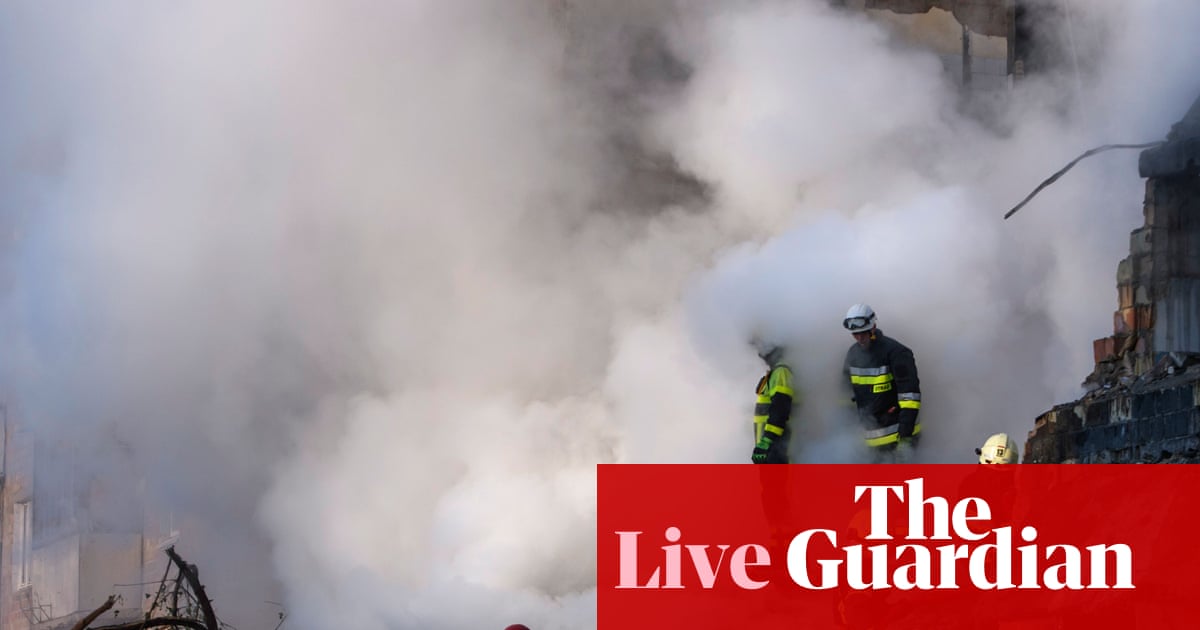
Ukrainian president Volodymyr Zelenskyy said that at least 23 people were killed in yesterday’s Russian attacks on Kyiv, including 22 people on a single site in the city’s Darnytskyi district.
More than 50 people were injured, and 8 people are still missing.
On Friday morning, Zelenskyy reiterated his call for Russia to be held accountable for these strikes.
He said:
“When instead of diplomacy Russia chooses ballistics, continues to modernize ‘shaheds’ for killing, and deepens cooperation with actors like North Korea, it means the world must respond accordingly.
Strong sanctions, strong pressure, strong steps are needed so that the murderers do not feel impunity.”
EU defence ministers are meeting in Copenhagen today to discuss what else the bloc could do when it comes to both pressure on Russia to bring it to the negotiating table, and support and security guarantees for Ukraine.
Arriving for the meeting this morning, EU’s foreign policy chief Kaja Kallas said:
“These attacks show that Putin is just mocking any kind of peace efforts that are made. So what we have to do is increase pressure on Russia.”
Expect that to be a recurring theme in the ministers’ comments throughout the day.
We will also hear from the European Commission president, Ursula von der Leyen, as she is touring member states on the eastern flank, and from the French president, Emmanuel Macron, and the German chancellor, Friedrich Merz, as they are meeting for a Franco-German summit in Toulon.
I will bring you all the key updates here.
It’s Friday, 29 August 2025, it’s Jakub Krupa here, and this is Europe Live.
Good morning.
in Kyiv
Photographs by Julia Kochetova
At a five-storey residential apartment block in the Darnytskyi area in the east of the city, residents said they had heard Russian bombing in the distance. It was a familiar sound, and many had gathered away from the windows in central corridors that extended along the block, only for disaster to strike.
“We didn’t understand what had happened,” said Oleksandr Yastremskyi, who had taken refuge in a corridor with his wife, Tetiana, and their son Denys. “It’s like something had landed into our house. And then we heard people screaming.” A hundred metres away, the other end of their building collapsed, sending, according to Tetiana, “a big wave of dust and smoke” in their direction.
Ivan Zhelezko, a serving soldier, looked across at his bombed second-floor flat, its balcony hanging at an unsustainable angle. Around him in bags were a handful of possessions he had managed to take with him from the apartment where he lived with his family for 20 years.
Zhelezko said he was too stunned to be angry, describing himself as confused. Among those who died, he said, were his friend’s sister and the parents of a childhood friend.
The soldier explained that his family escaped because they left immediately after the first explosion, and he tried to insist the tragedy was “nothing new for me”. Such fatalism was hard to believe, though he added: “I’m just happy my family is alive.”
Those who moved fast or were simply at the other end of the building may have been able to escape unhurt but, such was the ferocity of the blasts, taking down all five storeys, they could only have been caused by a cruise or ballistic missile attack, giving those in the path of the rockets no chance.
Given the meeting is held in Copenhagen, as Denmark holds the rotating EU presidency at the moment, some ministers get asked about the recent allegations of US influence operations in relation to Greenland.
Ireland’s Harris declared his full support for Denmark in response, saying:
“Ireland fully supports and stands with the people of Denmark and the Danish government in relation to Greenland.
I think it’s important that every country in the European Union stands with Denmark in relation to this matter.”
We are getting first lines from Copenhagen, where EU defence ministers are meeting this morning.
Ireland’s Simon Harris joined the growing chorus of those calling for a stronger reaction, including further sanctions.
He said:
“I’m absolutely appalled by the actions of Russia in terms of the attack on Kyiv and indeed the attack on the European delegation office there. This cannot be a consequence free zone.
I think it’s very important that the entire world speaks with one voice in its absolute condemnation of Russia’s clear breach of the Vienna Convention.
What’s also clear is that while the world is talking about peace, and how do we bring about peace and dialogue and diplomacy to end the war on Ukraine, it’s quite clear that Russia is continuing to engage in the actions of terror, attacking a civilian population, showing no willingness for a ceasefire, and therefore, I think it’s imperative that those of us in the European Union now consider further sanctions.”
Earlier, Estonia’s defence minister Hanno Pevkur argued that the best security guarantee for Ukraine would be membership in Nato.
Lithuanian minister, Dovilė Šakalienė, called for secondary sanctions on Russia and its partners, arguing it would be the most efficient way to stop funding the Russian war machine.
Ukrainian president Volodymyr Zelenskyy said that at least 23 people were killed in yesterday’s Russian attacks on Kyiv, including 22 people on a single site in the city’s Darnytskyi district.
More than 50 people were injured, and 8 people are still missing.
On Friday morning, Zelenskyy reiterated his call for Russia to be held accountable for these strikes.
He said:
“When instead of diplomacy Russia chooses ballistics, continues to modernize ‘shaheds’ for killing, and deepens cooperation with actors like North Korea, it means the world must respond accordingly.
Strong sanctions, strong pressure, strong steps are needed so that the murderers do not feel impunity.”
EU defence ministers are meeting in Copenhagen today to discuss what else the bloc could do when it comes to both pressure on Russia to bring it to the negotiating table, and support and security guarantees for Ukraine.
Arriving for the meeting this morning, EU’s foreign policy chief Kaja Kallas said:
“These attacks show that Putin is just mocking any kind of peace efforts that are made. So what we have to do is increase pressure on Russia.”
Expect that to be a recurring theme in the ministers’ comments throughout the day.
We will also hear from the European Commission president, Ursula von der Leyen, as she is touring member states on the eastern flank, and from the French president, Emmanuel Macron, and the German chancellor, Friedrich Merz, as they are meeting for a Franco-German summit in Toulon.
I will bring you all the key updates here.
It’s Friday, 29 August 2025, it’s Jakub Krupa here, and this is Europe Live.
Good morning.