
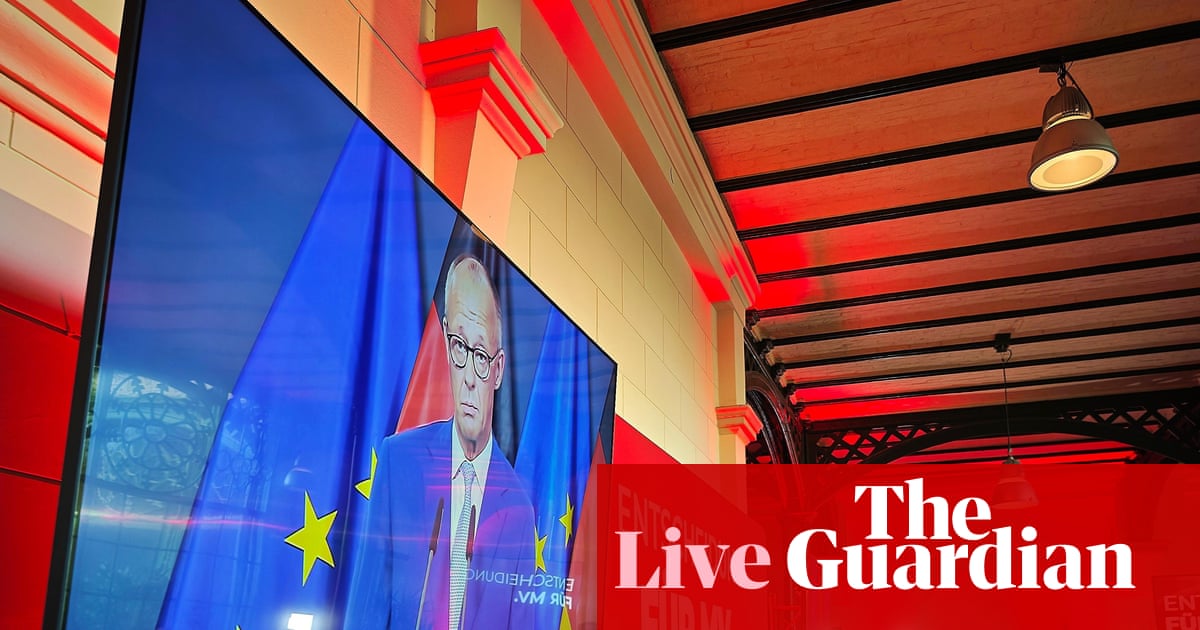
Good morning and welcome to our Europe live blog, where we’ll start in Germany after a bruising night for Friedrich Merz’s party.
The German chancellor is staring down pressure over his leadership and authority after the CDU suffered heavy losses in two regional elections. For the first time in 77 years, it’s failed to enter a state parliament, in the former East German state of Mecklenburg- Vorpommern.
This was the home state of former CDU chancellor Angela Merkel; the party there last night pulled just 4.9% of the vote, losing more than half of its support.
Many of its voters have flocked to Alternative for Germany (AfD). The far-right, anti-migrant party gained 38% of the vote, doubling its share to now become the largest party in the state. This result comes just a fortnight after AfD romped to a majority in Saxony-Anhalt.
Merz called it a “disaster” last night in a public address, but vowed to stay the course and press on with his government’s reforms.
Also rolling in this morning are the numbers from Russia’s orchestrated lower-house election, where Vladimir Putin’s party has retained a huge majority against token opposition.
Electoral officers say the ruling United Russia party is on track to gain 355 of the 450 seats in the State Duma – even larger than the previous 2016 record.
It’s the first election since the Kremlin launched the full-scale invasion of Ukraine four-and-a-half years ago and parties critical of Putin were excluded from the vote.
The EU’s Kaja Kallas has slammed the sham this morning, calling it “another major setback for Russian democracy.”
“Their outcome was never in doubt,” she writes.
“The Kremlin silenced dissent, barred the only registered party that opposed its war in Ukraine, and shut out international election monitors. The veneer of democracy is all that remains in Russia.”
The CDU also lost its majority in Berlin yesterday to the hard-left Die Linke which gained 25.7% of the vote.
We’re expecting a press conference from Merz at 1.30pm local time following this morning’s meetings with party seniors and CDU state governors.
The eight of them backed Merz in a letter released last week. However, that was before the drubbing in Mecklenburg-Vorpommern.
Some critics have already started calling for Merz – 16 months in office- to step down. But is Merz’ personal popularity the issue here?
“I don’t see that swapping out a leadership figure would really bring a change,” Education Minister Karin Prien, who is also a deputy CDU leader, has told Phoenix television. She said she doesn’t see “another personnel offer” coming.
“So we must now discuss with one another — together with the chancellor as a government, and on the other hand as a party — how we win more acceptance and more credibility among the population.”
Good morning and welcome to our Europe live blog, where we’ll start in Germany after a bruising night for Friedrich Merz’s party.
The German chancellor is staring down pressure over his leadership and authority after the CDU suffered heavy losses in two regional elections. For the first time in 77 years, it’s failed to enter a state parliament, in the former East German state of Mecklenburg- Vorpommern.
This was the home state of former CDU chancellor Angela Merkel; the party there last night pulled just 4.9% of the vote, losing more than half of its support.
Many of its voters have flocked to Alternative for Germany (AfD). The far-right, anti-migrant party gained 38% of the vote, doubling its share to now become the largest party in the state. This result comes just a fortnight after AfD romped to a majority in Saxony-Anhalt.
Merz called it a “disaster” last night in a public address, but vowed to stay the course and press on with his government’s reforms.