
A bill co-authored by Lindsey Graham, the South Carolina senator who died earlier this year, that would give Donald Trump broad authority to tariff Russia and its trading partners will be put forward for a vote this week in a high-stakes legislative battle that could provide new sanctioning authority to the US president at a crucial moment in Russia’s war against Ukraine.
The bill is facing considerable pushback not only from Ukraine-sceptic Republicans, however, but also from prominent Democrats who say that the bill will give undue tariff power to the US president that could then be abused and turned against US allies.
Congressional staffers have described frenzied last-minute lobbying in the halls of Congress as the vote approached for what one Democratic staffer called the “one opportunity that we have to help Ukraine before they enter the slow winter”. The bill passed a vote in the House rules committee on Monday, and is due for a rule vote on the House floor on Tuesday afternoon, then a general vote on Wednesday.
The Lindsey O Graham Sanctioning Russia Act of 2026 would target Russia’s energy and defense industries, as well as the country’s “shadow fleet” of tankers skirting existing oil sanctions, and would give Trump new authority to slap 100% tariffs on top purchasers of Russian oil, including China and India.
But Trump’s use of tariffs against US partners such as Canada and Mexico have made expanding his powers a controversial aim – even for senior Democrats who have been stalwart backers of Ukraine. They are led by the representative Gregory Meeks; the top Democrats on the House foreign affairs committee; the representative Don Beyer of Congress’s joint economic committee; and Richard Neal, the ranking Democrat on the House ways and means committee.
In a statement, they said the legislation would do “more harm than good”. “This bill would dramatically expand presidential tariff authorities while failing to mandate sanctions on Russia, both of which are unacceptable,” they said. “These flaws would raise Americans’ prices while undermining support for Ukraine in the long term.”
Critics have accused those Democrats who oppose the bill of not wanting to hand Trump a win before the midterm elections, effectively holding the bill hostage to partisan politics with Ukraine on the cusp of another brutal winter with dwindling munitions to protect itself from attacks from Russian missiles.
“It’s not about denying Trump a victory,” Neal said in an interview on Monday. “I just feel that the abusive nature of these tariffs, the way he’s used them to drive away friends across the globe, what is our protection afterwards? And if he decides, by the way, to take the harsh position as it relates to Ukraine, he could still do that as well.”
Sources said negotiations are under way among Democrats to propose changing the bill to limit the number of countries eligible for sanctions to 11. One of the co-sponsors of the bill, the representative Steny Hoyer, offered an amendment on Tuesday that identified 10 countries subject to the secondary sanctions as China, India, Turkey, Azerbaijan, Hungary, Kazakhstan, Kyrgyzstan, Singapore, Slovakia and the United Arab Emirates.
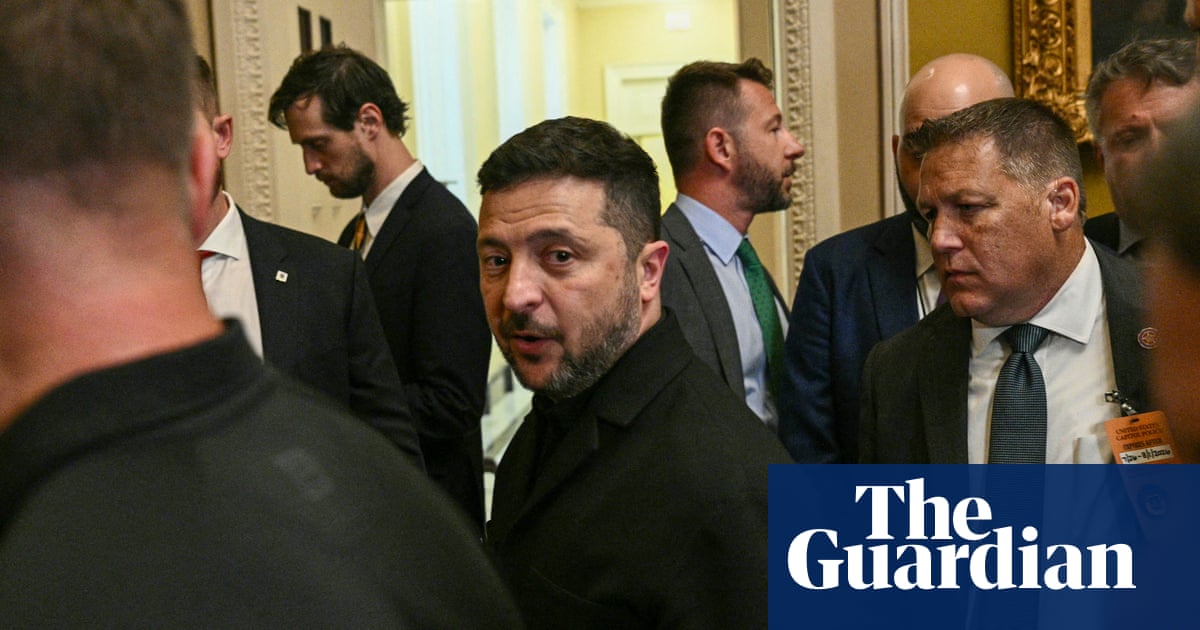
Ukraine’s president, Volodymyr Zelenskyy, on Monday encouraged the US to increase pressure on the Russian economy to end the war.
“Lindsey Graham’s sanctions bill is still a bill, unfortunately, and not a law,” he said in a nightly address. “It is important that it becomes law. I thank everyone around the world who supports this approach and who knows that strength works.”
In an interview on the sidelines of the Ukraine Action Summit in Washington DC on Saturday, Vitaly Kim, a member of Zelenskyy’s cabinet who serves as minister of veterans affairs, said economic pressure on Russia was the quickest route to end the war.
“International support through sanctions to stop Russian economy, so they cannot buy weapons … will help destroy their economy,” he said, comparing the effect to Ukrainian strikes on oil refineries and military plants.
“Your politicians see that our tactics to attack the economy of Russia and destroy the military sector of Russia are working. From my opinion, you will support us in this direction to attack the economy of Russia to make them stop.”
Trump is understood to have given Republican allies in Congress the go-ahead to submit the bill, breaking a more than two-year deadlock that carried through the death of Graham, who lobbied the president to back Ukraine even while remaining one of his closest allies and defenders in Congress.
Lawmakers from the isolationist wing of the Republican party have said they won’t back the bill, making Democratic support crucial. That has led to infighting among congressional Democrats, who sparred during a meeting this week in which the representative Linda Sánchez, a California Democrat, told members of her party to “get off the fucking bill”.
“I said what I said,” she wrote on social media by way of confirming the quote, which was first reported by Punchbowl News. “We absolutely must support Ukraine and punish Russia for its invasion. But why the fuck would we give Trump more power to tariff whatever country he’s currently mad at and drive up costs further for working families?”
The bill is being closely watched by foreign governments and advocates for Ukraine, who have said that it is the best option available and is broadly supported by the US public.
“It’s disappointing that some Democratic leaders are pushing against this pro-Ukraine bill,” said Mykola Murskyj, senior adviser at Razom, a US non-profit that advocates for pro-Ukrainian legislation. “Draining Russia’s war coffers is the most effective way to get the Kremlin to end its war. We should all be able to get behind that.
“These tariffs are crucial for ending Russia’s war,” he added. “Countries buying Russian oil and funding Russia’s war should no longer be able to that with impunity. They should face a choice: cheap access to the American market, or bloody Russian oil.”