
Russia hasn’t yet killed large numbers of Europeans outside Ukraine, but it’s getting closer. The night of 4-5 August, an airport bus driver discovered an armed drone lying near the tarmac of the Leipzig-Halle airport, which is a central hub of Europe’s logistical support to Ukraine’s war effort. A cargo jet, meanwhile, may have struck a second drone shortly after takeoff, forcing an abrupt landing, and investigators found a third drone laden with military explosives nearby.
In 2024, incendiary devices hidden in parcels ignited in DHL cargo at the same airport. Had these detonated in the air, a major air catastrophe and large-scale civilian casualties would have ensued, probably resulting in a broader war.
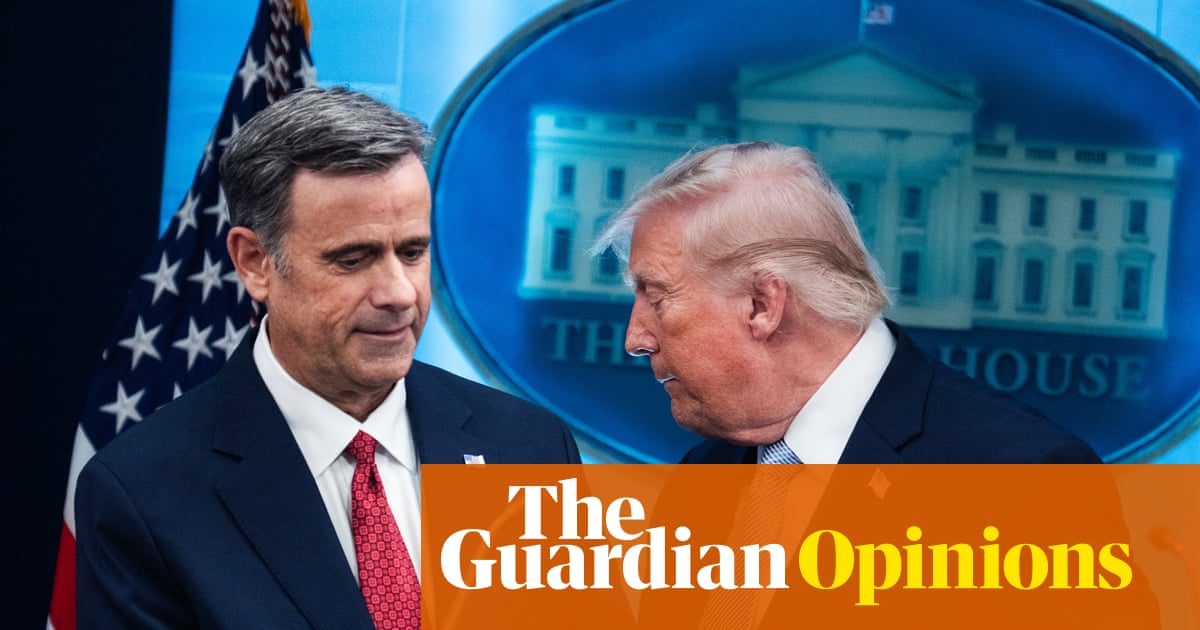
The most recent incident may be what prompted the CIA director, John Ratcliffe, to get on a plane for Moscow last week. There, according to reports, he warned his counterparts against attacks on Nato territory, urged them to curb support for Iran, argued that escalation in Ukraine would backfire, and pressed for a deal with Ukraine to end the war.
Ratcliffe’s trip is unlikely to have much impact on the Kremlin’s plans for an escalation against Ukraine in the coming months – but it is further evidence of the dangerous and growing enmeshment of the Iran and Ukraine wars.
Sending Ratcliffe to Moscow is a logical choice for the White House, given the substantial role the intelligence services play in Putin’s government and justifiable concern that he may be getting too-rosy assessments of the war from his own team. The attempt at diplomacy is to be applauded. Nevertheless, the Trump administration’s refusal to end the war with Iran is working at cross purposes with their effort to end the war in Ukraine. They are steering into the storm, not out of it.
One of the reasons for Ratcliffe’s visit to Moscow, according to the Washington Post, was to dispel the Kremlin’s belief that the Trump White House was distracted from Ukraine by Iran. Good luck with that. The reporting on the severe depletion of US interceptor stocks from the war on Iran is so extensive it can only have encouraged Vladimir Putin to launch even more deadly missile strikes against Ukraine’s defenseless population.
Ukraine, for its part, has sent 228 specialists and truckloads of drones to assist the Gulf states in their defense against Iranian missile strikes, prompting at least one Iranian lawmaker to declare Ukraine fair game for its own attacks. And Ukraine struck an Iranian commercial vessel in late July. Russia has meanwhile provided Iran with battlefield intelligence that make its strikes more deadly. Moscow has, of course, also long benefited from Iranian-designed drones to attack Ukraine.
Both conflicts are getting worse and going nowhere at the same time. True, Putin is in a pinch, with an economy badly damaged by Ukrainian strikes against Russian oil refineries and logistics hubs, but the pinch will just as easily prompt Russia’s leader toward escalation as it will restraint – especially if he sees the US distracted again in the Middle East and believes he has a window of opportunity to deal a crushing death blow to Kyiv.
Putin, like Zelensky, like Trump, and like the Iranian leadership, faces the same sunk-cost dilemma that has led so many of history’s wartime leaders to double down on fruitless military operations – from Alcibiades in Sicily, to Napoleon in Russia, to LBJ in Vietnam. If today’s leaders follow suit, the costs and escalation risks will mount while the conflicts fuse further.
Meanwhile, Xi Jinping and Putin met on Monday and will join Iran’s leaders in Bishkek this week for the annual summit of the Shanghai Cooperation Organization. They will discuss their plan to link their energy markets even more closely and probably condemn the new “economic offensive” that the US treasury secretary, Scott Bessent, announced last week to intensify pressure on Iran. Beijing may not want to see either war continue, but it also does not want to see Russia or Iran lose outright, and it is still in a strong position to avoid this outcome by helping the Iranians and Russians stave off the worst effects of the war on their economies and populations.
Ratcliffe’s trip was necessary, especially in light of Russia’s reckless grey-zone operations in Europe. But it will not be enough. His predecessor, Bill Burns, once went to Moscow in an effort to warn Russia against attacking Ukraine. That intervention fell on deaf ears, as Ratcliffe’s also will.
Clearer plans to end both wars through more positive inducements are badly needed.
To start, Washington should settle with Iran by unfreezing assets and offering sanctions relief in exchange for a real ceasefire and a framework arrangement for joint control of the strait by the littoral powers. It can then work to mitigate the consequences of this loss with a major push to diversify energy supplies – through alternative routes out of the region, alternative sources such as Venezuela, and a push on renewables. Ukraine, meanwhile, needs to become more serious about neutrality. It also needs a real debate about whether hanging on to the remainder of the Donbass it controls is worth indefinitely perpetuating the war.
In the conclusion to his recent book, The Coming Storm, which traces the parallels between today’s world and the world on the eve of the first world war, the historian Odd Arne Westad writes: “A key lesson of the world before 1914 is that regional conflicts, long left unresolved, can be the powder kegs that set off a global conflagration.” As the Iran and Ukraine conflicts intertwine without an end in sight, the world’s leaders should take such warnings far more seriously. But without real pressure from their citizens, they may not.
History is not doomed to repeat itself. But you don’t need to be a renowned historian to recognize the dangers the world is throwing up before us, nor to lament the failure of our leaders to calm these storms.
-
Christopher S Chivvis is a senior fellow and director of the American Statecraft Program at the Carnegie Endowment for International Peace. He served as the United States national intelligence officer for Europe from 2018 to 2021