
Good morning. Another week, another diplomatic success for Volodymyr Zelenskyy. On Monday, his first meeting with Andy Burnham as PM confirmed continuity in the UK’s steadfast support for Ukraine. “We’ve got your back,” Burnham said as the pair spoke in Portsmouth. Yesterday, in Washington DC, after attending the funeral of Lindsey Graham – a once supportive Republican senator – Zelenskyy and Trump held a “positive and productive” meeting, as per the White House. Overnight, the US Senate advanced a sweeping Russian sanctions bill.
Save for that somewhat shaky start in the early days of Donald 2.0, these well-executed global stage set-pieces have come to define Zelenskyy’s wartime leadership. The hundreds of billions he has secured in military, financial and humanitarian aid from the US, Europe, the UK and beyond during a period of global economic unease is remarkable.
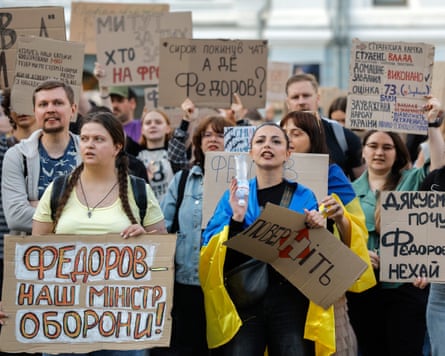
At home, however, Zelenskyy’s grasp of statecraft appears less comprehensive. Today, he returns to Kyiv to face another political crisis, with daily protests continuing in Ukraine, after the dismissal of popular defence minister, Mykhailo Fedorov. And it’s not the first time one of his domestic decisions appears to have involved serious miscalculation.
For today’s First Edition, we explore the challenges facing Zelenskyy on the home front and the battlefield, as Luke Harding, the Guardian’s senior international correspondent, shares the latest from Ukraine. Before that, this morning’s headlines.
Five big stories
-
UK news | Young people will be expected to engage with new support to find work, Pat McFadden has said.
-
World news | At least 13 people have been killed after a 6.8 magnitude earthquake struck southern Japan, injuring hundreds and knocking out power and water to tens of thousands.
-
Europe news | Nearly 4,000 people have been evacuated from tourist sites on France’s Atlantic coast as the return of winds and extreme heat jeopardises firefighters’ battles to contain wildfires raging in France and Spain.
-
US news | Donald Trump hosted back-to-back White House meetings with Volodymyr Zelenskyy and Benjamin Netanyahu on Tuesday, as Ukraine seeks more firepower for its air defences and the Israeli prime minister tries to repair his strained relationship with the US president.
-
UK news | Led By Donkeys has received compensation after a giant banner it displayed in Parliament Square saying “Yes It’s A Genocide” was seized by officials and destroyed.
In depth: ‘There’s a standoff between Zelenskyy, Fedorov and civil society’
Since taking up the Ukrainian defence brief in January this year, Fedorov proved himself effective. The 35-year-old former digital transformation minister and deputy PM hit the ground running. “Fedorov is seen as a young, modernising tech-savvy reformist,” Luke tells me, from his apartment in Kyiv. “Here in Ukraine, Fedorov is believed to have cleaned up a defence ministry plagued by Soviet era practices and alleged corruption.”
Fedorov upped pay and modernised contracts for infantry, and introduced more transparent processes for procurement. There have been reports he identified significant murky military overspend. He messaged Elon Musk on X to request Starlink be switched off for Russian soldiers, and Musk obliged. It was a coup for Ukraine, and massively impactful on the battlefield. And despite his short tenure, Fedorov achieved change on the frontline too. He is a proponent of data-driven, hi-tech warfare – an approach which has shifted fighting to Ukraine’s advantage.
Vibes-wise, at least, the contrast between Fedorov and Oleksandr Syrskyi – Ukraine’s 61-year-old erstwhile old school army chief – couldn’t be starker. “The culture around Syrskyi was extremely deferential and rather Soviet,” Luke says. “His reputation is that of a micromanager who hadn’t adapted to the changing nature of the war, fighting with infantry in the traditional way which comes with heavy losses.”
While the details remain unclear, Fedorov and Syrskyi clashed. Earlier this month, Zelenskyy announced a government reshuffle. Among the top tier changes was the removal of Fedorov, while Syrskyi remained in post.
It was a curious choice. He may be popular, but Fedorov appeared (previously, at least) to pose no political threat to Zelenskyy. He was a key ally and former aide to the president, a Zelenskyy loyalist. “He’s not someone who previously had independent political ambitions,” says Luke. Now, he is emerging as a potential successor.
Polling found 72% of respondents were against Fedorov’s dismissal, with only 5% for. Last week, under mounting public pressure, Zelenskyy attempted to change course. Syrskyi was sacked, and Fedorov invited back into government. It appeared the crisis was averted. Only, Fedorov has since turned down alternative senior ministerial posts, while Zelenskyy is yet to re-offer him the defence gig. “Only three positions in the state … determine the course of the war: president, defence minister and commander-in-chief,” Fedorov said in a statement.
“There’s a standoff between Zelenskyy, Fedorov and civil society,” says Luke, “and it shows no signs of resolving.”
Reforms, not scams
It’s not the first time Zelenskyy – a highly skilful diplomatic operator – has made what appears to be impulsive, certainly unpopular, personnel decisions.
In July 2025, a wave of protests erupted in Kyiv and other major cities, in response to the Ukrainian government’s proposals to strip two major anti-corruption bodies of their independence. Despite these demonstrations, Zelenskyy signed the bill into law, before eventually backtracking under public pressure a few months later. “It was an enormously unpopular move,” Luke says, “and a bizarre decision to make.” One of these organisations (NABU – the National Anti-Corruption Bureau of Ukraine) subsequently investigated Zelenskyy’s chief of staff Andriy Yermak who was widely understood to have been pushing for the reforms. It led to his abrupt resignation.
One year on, protesters in Kyiv have been returning to the very same spot to again voice concerns about Zelenskyy’s judgment. “Initially, they were chanting ‘Syrskyi out, Fedorov back’.” Syrski’s subsequent departure, and Zelenskyy’s appointment of a younger, highly rated new commander-in-chief failed to placate protesters. Last Friday, Luke joined them at the Ivan Franko Square – connected to Bankova Street, home of the Presidential office. “The message had shifted,” Luke observed. “They still sang the national anthem and want Zelenskyy to succeed, but now they’re chanting ‘reforms not scams’, and ‘the people are the power’.”
A path to victory
This comes at a significant juncture for Ukraine. Wartime martial law bans elections, so Zelenskyy has been in power since 2019, when he won a stonking majority. Despite pressure from Putin (and at times Trump) to call a fresh election, polling shows appetite is low for a pre-peacetime vote, with six million Ukrainians now based abroad, and indiscriminate Russian airstrikes posing a risk to any public gatherings. Still, reports suggest the government had explored options for holding a (ceasefire dependent) election as soon as this year, with Zelenskyy apparently negotiating with his rivals. Fedorov’s trust rating has climbed in recent weeks, overtaking Zelenskyy; it’s a trajectory worth tracking.
Meanwhile, the war is rapidly changing shape. Fedorov (and Syrskyi, who created Ukraine’s standalone drone department) have shifted focus from ground to sky. Luke has just returned from meeting one drone unit, which claims to have “destroyed the majority of Russia’s air defences” with their homemade kit. “What was once Russia’s great strength – its size and strategic depth – is turning into a liability,” says Luke. “Ukraine has regained the initiative.” Russia continues to slowly advance, but at a price of 30,000 dead and wounded troops per month.
“I wouldn’t say Ukraine is winning,” cautions Luke, “but it’s taking a path to victory that is more convincing than anything we’ve seen since 2022.”
Power struggle
A difficult decision now sits at the top of Zelenskyy’s in-tray: reinstate Fedorov and take the politically embarrassing hit; or stand his ground, and hope the protests peter out.
“There’s a suggestion that lots of vested interests don’t want Fedorov back as it’ll hurt them financially,” says Luke. “The protesters I spoke to believe that certain people around Zelenskyy are benefiting from the old system that Fedorov was challenging. That can’t be proven, but it’s what many Ukrainians think.”
Last year’s (botched) attempts to change those anti-corruption bodies adds to this suspicion.
Whatever motivated the initial reshuffle, to many the Fedorov/Syrskyi debacle represents something existential. “It’s a struggle for Ukraine’s soul,” Luke says, “between a younger western, progressive and inclusive generation who want Ukraine to be in the European mould, and the Soviet-inflected, insider-oriented older guard who operate in deals and handshakes and yes, some corruption.”
There is, of course, an alternative read on the public outpouring of frustration. The protests have been policed with a distinctly light-touch. Even as Russia’s violent assault continues, with UN figures showing last month as the deadliest for Ukraine’s civilians in four years, civic life continues. “It shows people understand all this isn’t just about beating Russia,” says Luke, “but constructing a decent, fair, modern, forward-looking society after victory.”
What else we’ve been enjoying

-
“Put me through to real person” is something I often find myself typing when faced with an AI customer chatbot. I was heartened to read this letter from a reader who feels the same way. Hettie
-
The Nigel Farage soap opera continues in Clacton, ahead of next month’s
vanity projectbyelection. For this in-depth piece, Tim Burrows spent a few days in this coastal Essex corner, perfectly capturing the mood there. Michael -
Elisabeth Zerofsky has written a fascinating piece for the New York Times Magazine about the ideological war consuming the Heritage Foundation, and how it got sidelined by the second Trump administration. Hettie
-
If you, like Thomas, by email have a less-than-perfect success rate when it comes to fresh pasta rolling, these tips from professional chefs will prove invaluable. It’s all about egg-size, apparently. Michael
-
After reading Gardiner Harris’s book No More Tears, a blistering exposé of Johnson & Johnson, I’ll never look at talcum powder in the same way. The company has been ordered to pay $5.5bn to resolve thousands of lawsuits alleging that its baby powder caused ovarian cancer. Hettie
Sport
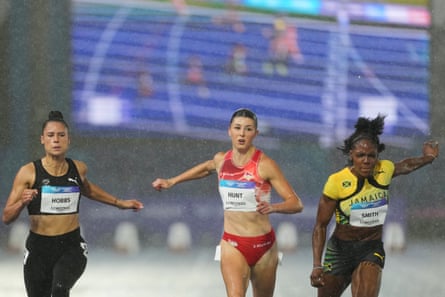
Commonwealth Games | Amy Hunt settles for 100m silver, after New Zealand sprinter Zoe Hobbs won the women’s 100m in a personal best of 10.93sec, while Emmanuel Eseme surged to the men’s 100m title in 9.83.
Football | The roads around the French football federation headquarters in Paris were closed off for Zinédine Zidane’s unveiling as head coach for France.
Golf | As she heads to Royal Lytham as a guest of the R&A for Thursday’s start of the Women’s Open, the inaugural winner Jenny Lee Smith gives us an interview.
The front pages
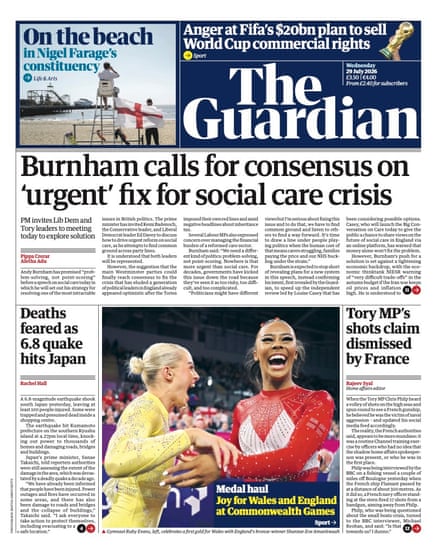
“Burnham calls for consensus on ‘urgent’ fix for social care crisis”, is the Guardian’s top headline today. On the same issue, the Telegraph writes “Workers face new tax to fund social care”, the Times has “Shake-up of social care to lock out private firms” and the Express says “2m missing out on social care they need”.
Still on politics, the Mail runs with “Burnham benefits ‘bribe’ for parents of apprentices”, the FT has “Burnham to seek private sector deals in growth push”, and Metro writes “£4k if you let your children learn a trade”. Elsewhere, the i Paper says “Fury over Fifa plan to sell off World Cup”, and on the same news the Sun writes “For sale”.
The Latest
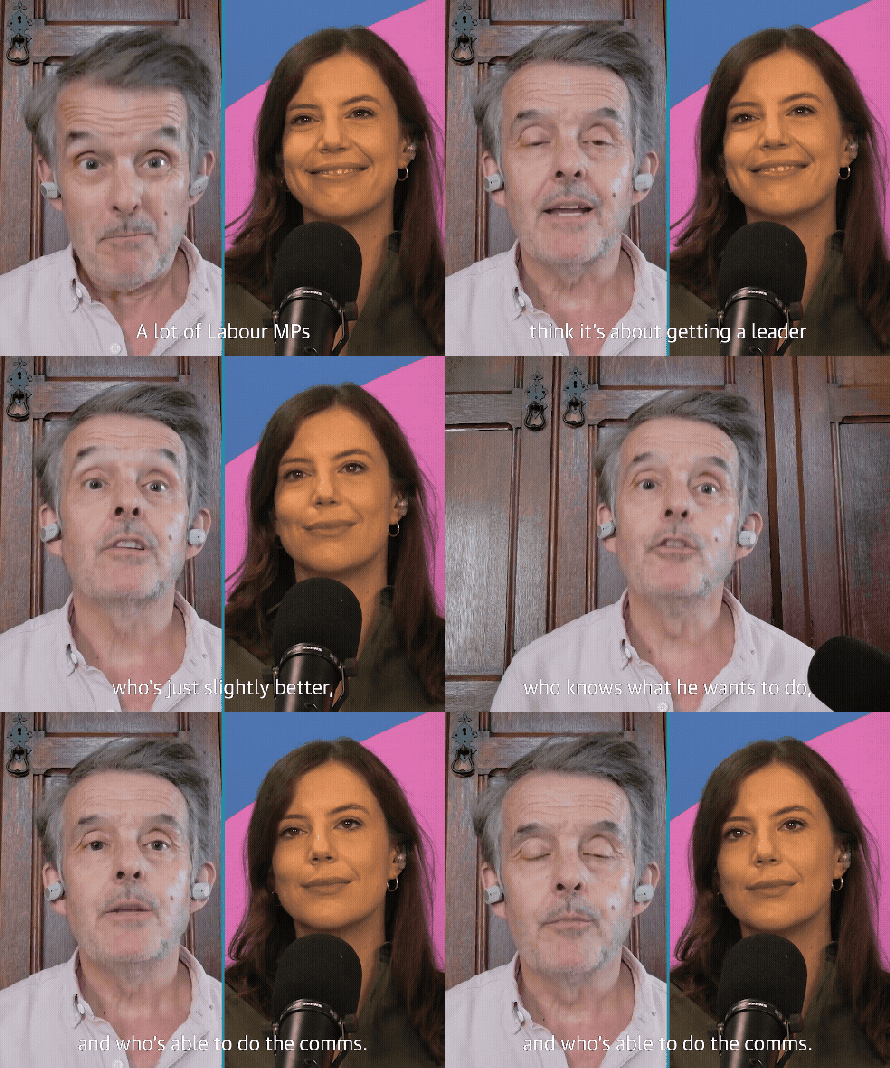
Labour overtake Farage’s Reform UK in polls
Labour has overtaken Reform UK this week for the first time since March last year, according to multiple polls. The ‘Burnham bounce’ comes two weeks into Andy Burnham’s tenure in No 10, during which he has made major announcements on the cost of living and localised education to reduce youth unemployment, and an announcement on social care is expected soon. Is this a turning point for the beleaguered Labour government – or simply a honeymoon for the new PM? Lucy Hough speaks to senior political correspondent, Peter Walker.
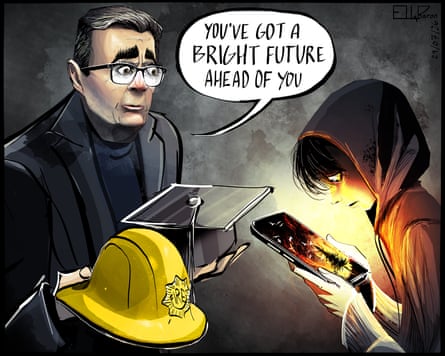
Cartoon of the day | Ella Baron
The Upside
A bit of good news to remind you that the world’s not all bad

Matthew Myerscough came to fossil hunting after he was caught in an avalanche. Revisiting his old hobby as a boy was a way to cope with stubborn memories of the accident, and the enduring panic he faced. Now, it’s opened up a world of treasures, including a dinosaur footprint and, spectacularly, a sea dragon – a marine reptile from the Jurassic period, washed up on Lavernock beach in south Wales.
His recent book details his “star finds”, and illuminates the strange, underground world of fossil hunting which gave him refuge in a moment of darkness.
“There’s this mindful, almost meditative state that I get into because I’m forgetting about all the other stresses and worries in life. I’m so focused on what I’m doing in that moment.”
Sign up here for a weekly roundup of The Upside, sent to you every Sunday
Bored at work?
And finally, the Guardian’s puzzles are here to keep you entertained throughout the day. Until tomorrow.