
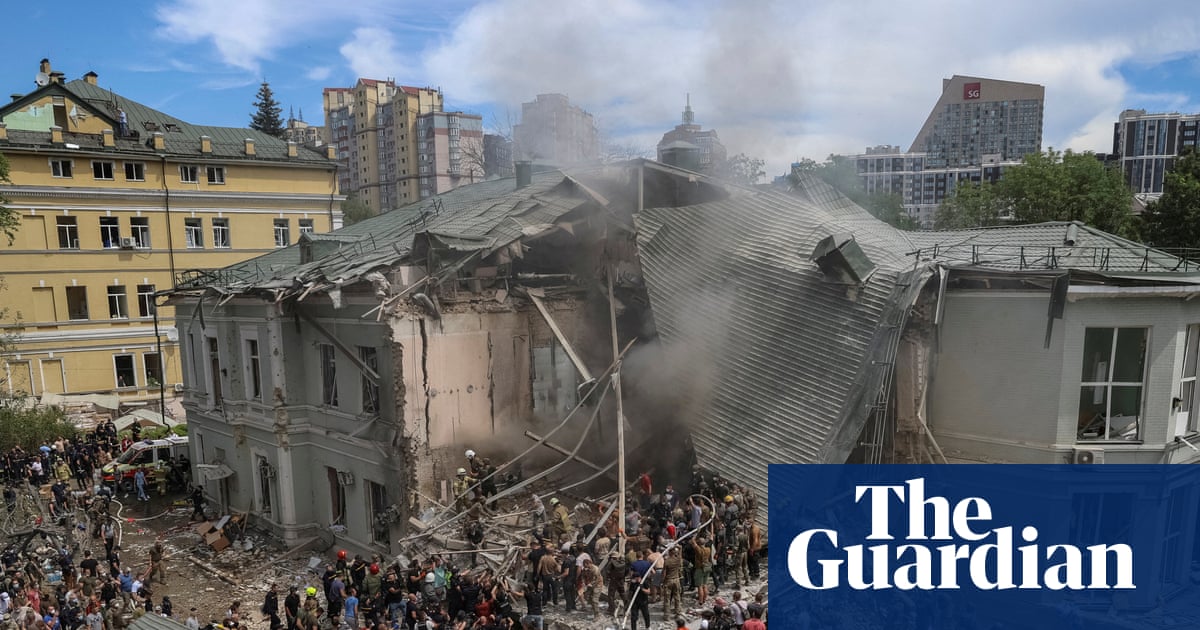
Twice every day, Liubov Martynenko leaves the underground maternity ward where she works in Kherson and travels by ambulance to collect meals from another hospital in the Ukrainian city’s “red zone”, close to the Dnipro River and the Russian forces on the other side.
On 4 June , just before midday, the vehicle entered the grounds of Luchansky city clinical hospital as usual, but Martynenko, who also works as a midwife, heard a strange sound in the air. “It’s flying!” the driver screamed, as she realised there was a drone nearby.
“It was so close, just a couple of metres away, a flying box with a black eye,” she told the Guardian this week.
The driver reversed sharply and it shot towards them, crashing into the side of the ambulance and exploding. Confused by the impact of the blast, Martynenko ran into a nearby clinic shouting that the driver had been killed. Both survived, however, receiving treatment for minor shrapnel wounds and concussion.
The vehicle, a donation from Italy, was clearly marked “ambulanza” and with a red cross on the roof – the internationally recognised legal symbol of protection and neutrality. Martynenko was wearing a red flak jacket, often worn by frontline medical workers to identify them.
“If it weren’t for the driver’s quick reactions, the drone would have hit the front of the vehicle and we probably would have died,” she says. “The Russian operators attacked precisely on the hospital grounds – and it’s not the first time it has been hit, either.”
The incident is part of a growing pattern of attacks on medical workers and health infrastructure in conflict zones. From Sudan to Myanmar, the Democratic Republic of the Congo and Afghanistan, such incidents have more than doubled globally since 2021.
Fuelled by the start of Russia’s invasion of Ukraine in 2022 and Israel’s war in Gaza in 2023, figures peaked in 2024 but have remained at a historic high, with more than 2,500 documented incidents last year across 33 countries, according to the Safeguarding Health in Conflict Coalition.
Since Israel began a new offensive in Lebanon in March, there have been 247 incidents affecting healthcare and 148 health workers killed in the country, despite repeated ceasefires, according to Safeguarding Health In Conflict. Three hospitals were hit in southern Lebanon in just one week last month, with medical workers making up most of the 150 wounded.
Under international law, hospitals, healthcare workers and wounded people are afforded special protection. It was a founding principle of the first Geneva convention in 1864 and was reaffirmed 10 years ago when the UN security council adopted a resolution condemning such attacks.
In practice, however, those protections are steadily being eroded. Healthcare attacks have become so common that state actors are now regarded as routinely using them as a weapon of war by some experts.
“If you can’t even protect hospitals, the first line of humanitarian protections, then it will lead to the breakdown of all international law,” says Rohini Haar, an emergency doctor who lectures on human rights at the University of California, Berkeley. “I believe we are seeing that.”
Last year, the Guardian visited three frontline maternity hospitals in Kharkiv, Sloviansk and Kherson – the ward where Martynenko works – where women were forced to give birth in basements as drones circled overhead and explosions boomed nearby.
For the last few years, the vast majority of attacks have been carried out by state actors, which increasingly invoke “dual-use” claims to justify the assaults. Two of the worst offenders, Russia and Israel, argue that hospitals are used for military purposes, yet disclose little evidence publicly to back their claims.
Lawyers say the “dual-use” loophole does not legitimise these attacks, however, because international law requires that a target be verified as a military objective, that any harm is proportionate, and that advance evacuation warnings are given.
However, there has never been a standalone conviction for a healthcare attack in international courts. They have only appeared as part of broader war crimes charges, such as those brought against the Bosnian Serb commanders Stanislav Galić and Dragomir Milošević over the siege of Sarajevo.
It fits a wider pattern of a lack of enforcement for war crimes, allowing states and armed groups to act with near impunity.
The nature of warfare has changed too. Drones and long-range airstrikes are pounding cities and changing the idea of a defined battlefield, with military targets redefined as anything that might help to sustain the capability of a force.
The cost of these attacks is devastating for civilian populations. A cascade of preventable deaths often follow because of the lack of emergency care and disruptions to routine care, and because people stop visiting hospitals out of fear. It leads to unassisted childbirths, surges in preventable sickness and outbreaks of disease as vaccinations are halted.
The fallout can last for decades, medical experts warn, especially when trained staff are killed.
Liz Harding, a humanitarian representative at Médecins Sans Frontières, says: “Humanitarians and hospitals now almost have to justify why we shouldn’t be targeted rather than those launching the attacks having to explain themselves.”
After two weeks off, Martynenko is back at work, collecting meals from Luchansky for the patients on the maternity ward twice a day, but always in fear. CCTV footage of the attack appears to show the ambulance was struck little more than a metre away from the crater left by a previous explosion.
“I am scared to go to work after the attack, especially when I hear any kind of buzzing noise,” she says. “I have to do my job though.”