
Ukraine’s leading arms company is manufacturing about 100 long-range Flamingo cruise missiles a month, a rate able to support an enduring campaign of deep strike against targets hundreds of miles inside Russia.
Fire Point is also making FP-1 and FP-2 fixed-wing drones at a rate of “hundreds per day”, according to chief executive Iryna Terekh. Manufacturing at scale is restarting after a pause caused by the delay in signing off €90bn of EU lending to Ukraine.
The start-up’s development from its postwar foundation in 2022 demonstrates the rapid maturing of Ukraine’s homegrown defence industry, finally giving its military the long-range capabilities denied by the west earlier in the conflict.
“I’m not aware of any deep strike attack that was happening in the past few months that was not involving our products,” Terekh said. Missile and drone attacks using Fire Point munitions were taking place at a daily rate of “on average five to 15”.

Flamingo missiles, which can carry 1,150kg of explosive, enough to penetrate concrete walls, were used to attack a Russian military components factory at Cheboksary in June, more than 600 miles from Kharkiv, in Ukraine’s north-east.
Their actual flight distance, Terekh said, was among “the longest recorded in the history of cruise missile missions”, at about 1,800km (1,118 miles) because of the complexity of the flight path. Each Flamingo costs a little under $600,000, the chief executive said, cheaper than a US Tomahawk, which cost approximately $3.5m.
The lighter FP-1 drones in particular, which have a range of more than 1,000 miles, are used to attack less well defended Russian oil refineries in a campaign that has cut their production by 20% and led to long queues at petrol pumps. They cost between $55,000 and $75,000, Terekh added.
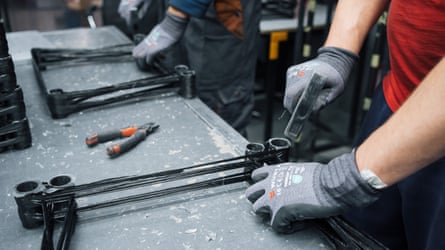
Fire Point now operates from 83 factories inside Ukraine, plus another in Denmark, employing 6,000 people, up from 3,500 late last year, according to Terekh. The Guardian visited one manufacturing site last December, where dozens of men were assembling the plywood, plastic and carbon fibre structures into whole drones.
“What we’re seeing now is the result of several years of effort by the Ukrainian side,” said Ben Hodges, a former general who commanded the US army in Europe. “They can not only reach deep inside Russia with precision and get past Russian air defences, their weapons also carry a payload big enough to achieve effect.”
The result is an evolution in the long-running war, where Ukraine is closing in on Russia’s ability to conduct deadly long-range attacks. Each month Russia produces up to 70 air-launched Kh-101 cruise missiles, 25 sea-launched Kalibrs, according to Ukrainian estimates, plus a further 60 Iskander M ballistic missiles.

Fire Point is also developing Ukraine’s first ballistic missiles, which Terekh hopes will be first launched by the end of the year.
A variant of the short-range FP-7, meanwhile, will form the basis of the separate Freyja initiative, an international effort aimed at creating an alternative air defence system to the US Patriot, involving Ukraine and nine other European countries. Fire Point will make the launchers and interceptors, with a target cost of $1m per interceptor.
“We adore Patriot,” Terekh said, but added that global manufacturing is nowhere near the current level of demand. Only Patriot systems are able to stop Russian ballistic missiles hitting Kyiv and elsewhere, but Ukraine’s stocks are out.
“The whole Pac-3 missile production, the worldwide production rate is around 600-700 missiles per year; and this is exactly the amount of Patriot missiles that were consumed in the Middle East in two weeks,” she added. It is now hoped the technology can be first tested by July next year.
Fire Point is largely owned by its founder, businessman Denys Shtilerman. Though Shtilerman held talks about selling a stake to Timur Mindich, a friend and former business associate of the president, Volodymr Zelenskyy, accused last year of running an energy corruption scheme, the founder says no deal went through.
Terekh, who studied architecture before joining Fire Point in the summer of 2023, when it employed 18 people, said the company is an example of how the Russian invasion has urgently forced Ukraine – once at the heart of Soviet industry – to modernise and regenerate itself.
“Ukraine, in a postwar economy, will need to be an exporter of things with a high additional added value. We do not want to be like a breadbasket any more for the world,” said Terekh, referring to Ukraine’s historical strength in agriculture. For now, however, the demands of the war mean Fire Point’s weapons are not exported.