
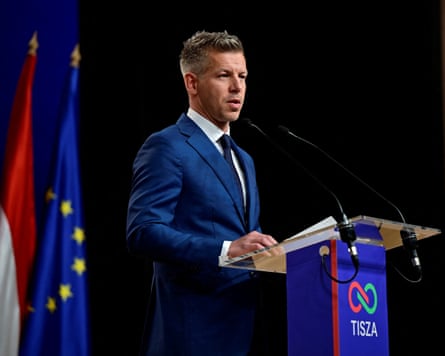
When future historians come to write about the stunning electoral overthrow of Viktor Orbán on 12 April 2026, let’s hope they devote at least footnotes to zebras and golden toilet brushes. The zebras were spotted by drones on the sprawling grounds of a countryside palace belonging to Orbán’s extended family. The 72 gilded toilet brushes were said to have been bought at a cost of almost €10,000, for a lavish renovation of Hungary’s central bank. For Orbán’s opponents, such excesses became symbols of the rampant corruption among cronies of Orbán’s ruling party Fidesz, which drained Hungary’s economy and earned the country the worst ranking on the crookedness league tables in the EU, as Ashifa Kassam and Flora Garamvolgyi reported.
In the end, it was disgust with corruption and how that corruption affected people’s livelihoods that were the main factors behind Sunday’s election rout. But the landslide achieved by Peter Magyar’s Tisza party – despite an electoral system designed to favour Fidesz – suggests that these eye-popping details were merely the last straws for a population desperate to reclaim their country as a functioning democracy.
Orbán’s rightwing populist rule has cast a shadow over Europe for almost 16 years. That he went without a fight, within hours of the polls closing, was the best news the continent’s beleaguered liberal democratic leaders could have hoped for.
How will the end of Orban’s self-styled “illiberal democracy” now reverberate beyond Hungary’s borders? Despite all the caveats and uncertainties, a panel of experts I commissioned on this question is a hopeful read. As our Guardian Europe columnist Nathalie Tocci summed up: “This marks a victory for liberalism in the world, even more than in Hungary itself.”
Historian Timothy Garton Ash, who covered the collapse of communism in Hungary in 1989, when Orbán was “a fiery young student leader calling for the Russians to go home”, echoed similar hope in his Guardian column. Garton Ash, who was among the joyful, almost disbelieving crowds on the banks of the Danube on Sunday night, says the critical question is whether Hungary can become the first country in the world to pull its democracy back from such far-reaching populist erosion “and whether Europe has the political will and imagination to enable it to succeed”.
Good news for Europe
After 16 years of Hungary behavng like a rogue state within the EU, an important reset is now on the cards. Orbán’s Hungary had lost all trust, becoming a geopolitical Trojan horse, or “Putin’s man in Brussels”, as Garton Ash puts it.
The incoming prime minister is no liberal. Magyar – profiled here – was in the Fidesz government before breaking ranks in 2024.
And while unseating Orbán is one thing, ridding the country of Orbánism is another. Poland’s recent experience shows how difficult it is to restore the rule of law after years of populist rule.
But Magyar has 70% of the seats in parliament, the crucial “supermajority” needed to dismantle Orbán’s system, and is committed to restoring democratic institutions.
On Monday he vowed to pursue those who “plundered, looted, betrayed, indebted and ruined” his country. Declaring an outbreak of peace with the EU, (which most Hungarians appear to want) he said: “we are not going there [to Brussels] to fight for the sake of fighting”.
Even if he initially only seeks a limited re-set to secure the release of €17bn in frozen EU funds for Hungary, the constructive approach his stated plan implies could be transformational.
Bad news for Russia
Orbán’s exit is not the outcome Russia wanted: Vladimir Putin has lost his closest ally in Europe. Ukraine’s president Volodymyr Zelenskyy called it “the victory of light over darkness”.
In his first post-election press conference, Magyar played down expectations of any dramatic rupture with Moscow. “If Vladimir Putin calls, I’ll pick up the phone,” he said, adding: “We cannot change geography.”
During the campaign, however, he framed the vote as a choice between east and west, and Hungarians decisively chose the western path.
The incoming PM is not keen on Ukraine joining the EU any time soon and all eyes are on what terms he sets for lifting Orbán’s veto of a crucial €90bn loan for Ukraine. “He was extremely cautious on this, pre-election,” said Mujtaba Rahman of the Eurasia group consultancy. “But without the need to appease Fidesz voters, Hungary will gradually move into the European mainstream.”
Mourning for the global Maga movement
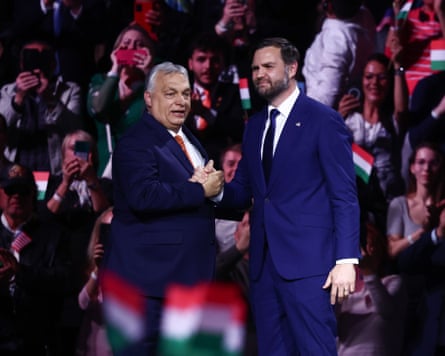
Donald Trump, Orbán’s other superpower backer, invested unusual amounts of political capital in keeping Orbán in power. Hungary has, after all, been a laboratory for the global Maga movement and offered the Trumpian project in the US a blueprint. The loss of the movement’s spiritual leader and Hungarian stronghold is a blow.
Conversely, as Robert Tait suggested, it carries “symbolic and psychological significance for American politics” out of all proportion for Hungary’s modest size and distance from the US.
Orbán’s ejection could interrupt Trump’s culture war against liberal democracy in Europe, too. It deprives the European far right of a network of Orbán-funded patronage via thinktanks and research bodies.
Yet Cas Mudde, a political scientist who has devoted more time than most to studying the far right, cautioned against assuming that Hungary’s election marks the start of a trend and that a similar defeat for the eurosceptic far right can be expected for example in the French presidential election next year. Hungary’s contest was fought principally on domestic issues. Nevertheless, the outcome disproved the fatalistic discourse that “wildly overstates” the weakness of democracy. Another bonus Mudde noted: there are, for now, no European far-right disrupters of Orbán’s stature who can fill his shoes.
Lessons for liberals
Democrats and progressives should draw the right conclusions from Magyar’s win, says Zsuzsanna Végh, of the German Marshall Fund of the United States thinktank. “While this was a very consequential election, the result offers no forecast for other European elections in the coming year. Orbán’s defeat was driven first and foremost by domestic factors such as the cost of living.”
As sociologist Tibor Dessewffy, of Eötvös Loránd University in Budapest, put it: “It turns out that hospital supplies mattered more to voters in Hungary than conspiracy theories about Brussels.”
For many progressives, however, the nearly 80% turnout and emphatic margin of victory in Hungary is uplifting. It shows that if people are galvanised to oppose authoritarianism, they will.
Tellingly, Végh says, Magyar veered away from far-right topics or attempts to outflank populist discourse, focusing instead on the cost of living, healthcare and other domestic issues.
Guardian columnist Polly Toynbee is nevertheless hopeful that Hungarian voters have rolled back the “forces of darkness”. Whether Orbán’s defeat ignites a fire across the continent could become clear within months. The slate of key elections next year includes Italy, Spain, Poland and France. As Polly advised, progressives should probably make the most of the good news now.
To receive the complete version of This Is Europe in your inbox every Wednesday, please subscribe here.