
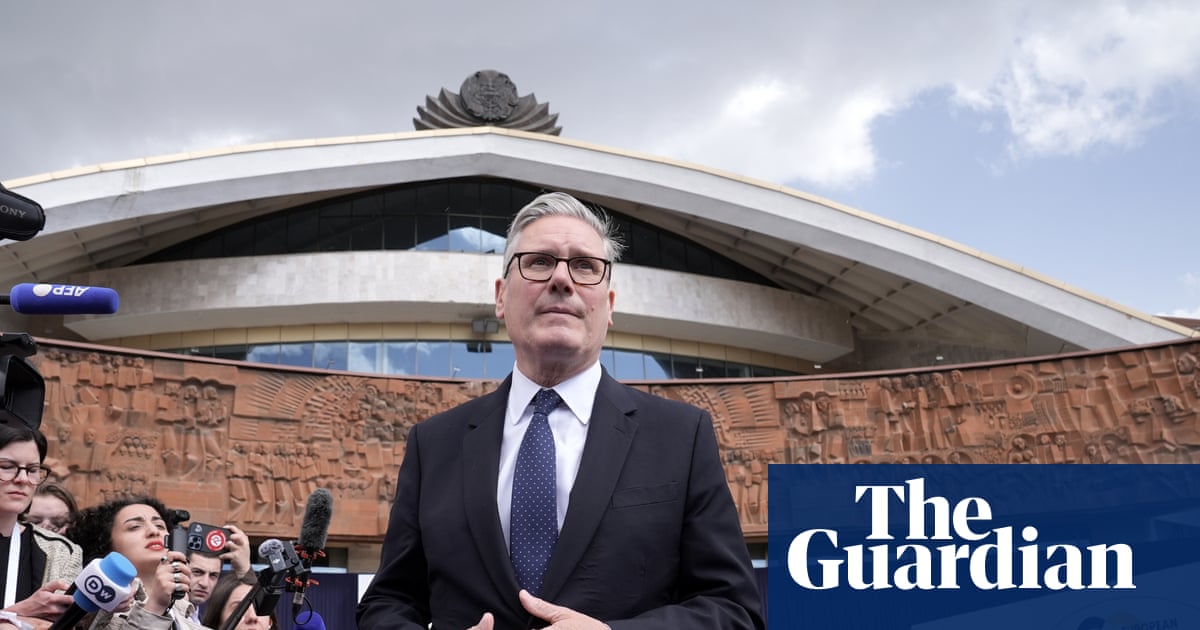
Keir Starmer has acknowledged that “tensions” between Donald Trump and Europe are high as he attends a summit of the European Political Community dominated by the conflicts in Ukraine and Iran.
With European leaders concerned over the US president’s waning interest in the Ukraine war, the prime minister will use the summit in Armenia to begin negotiations to participate in the European Union’s loan scheme for Kyiv.
Trump has also attacked traditional allies including the UK over their stance on the Iran conflict. Starmer said the damage done to economies around the world by the Middle East crisis would “play out” with electorates across Europe.
As the Nato military alliance comes under intense pressure from Trump’s threats, Starmer told the summit: “We cannot deny that some of the alliances that we have come to rely on are not in the place we would want them to be.
“There is more tension in the alliances than there should be and it’s very important that we therefore face up to this as a group of countries together.”
If the UK’s effort to join the EU’s £78bn recovery loan scheme for Ukraine is successful, British defence firms would be able to provide equipment for Kyiv in return for a financial contribution of up to £400m, expected to come from the £3bn already ringfenced for Ukraine.
But the EU expects the UK to go further in contributing to its budgets, in return for further access to its markets, after Starmer called for “deeper economic integration”.
Brussels has also called for a permanent mechanism for an “appropriate financial contribution” from the UK for more access, with deals already struck with the EU on food and under way for energy as part of the government’s reset.
At the summit in Armenia, the prime minister and the European Commission chief, Ursula von der Leyen, agreed to start talks on UK participation in an EU innovation fund and to be “ambitious” at this summer’s UK-EU summit.
European leaders agreed in March that the UK would have to pay into European structural and investment funds (ESIF) for the first time since Brexit if it wanted to participate in the EU’s single market for electricity.
It said this financial contribution should “appropriately reflect the relative size of the UK’s economy and the proportion of the internal market in which the UK aims to participate”.
Nick Thomas-Symonds, the Cabinet Office minister, accepted the UK was willing to make a financial contribution, arguing the principle was already well established, but suggested a reported figure of £1bn a year was incorrect.
“It’s about judging whether in particular areas, it represents our national interest, and value for money with the UK taxpayers. The approach I’ve used the last few years, I’ll continue to,” he told LBC radio.
The Cabinet Office is conducting an audit of which sectors could most benefit from further integration, with cars, chemicals and pharmaceuticals seen as a priority.
In interview with the Observer at the weekend, Starmer underlined his wish to negotiate closer links with the EU at the next “reset” summit this summer, saying the world had changed since the Brexit vote.
“It [Brexit] has damaged our economy and there’s no doubt in my mind where the national interest lies,” he said. “Britain must be at the heart of a stronger Europe on defence, on security, on energy, and on our economy.”