
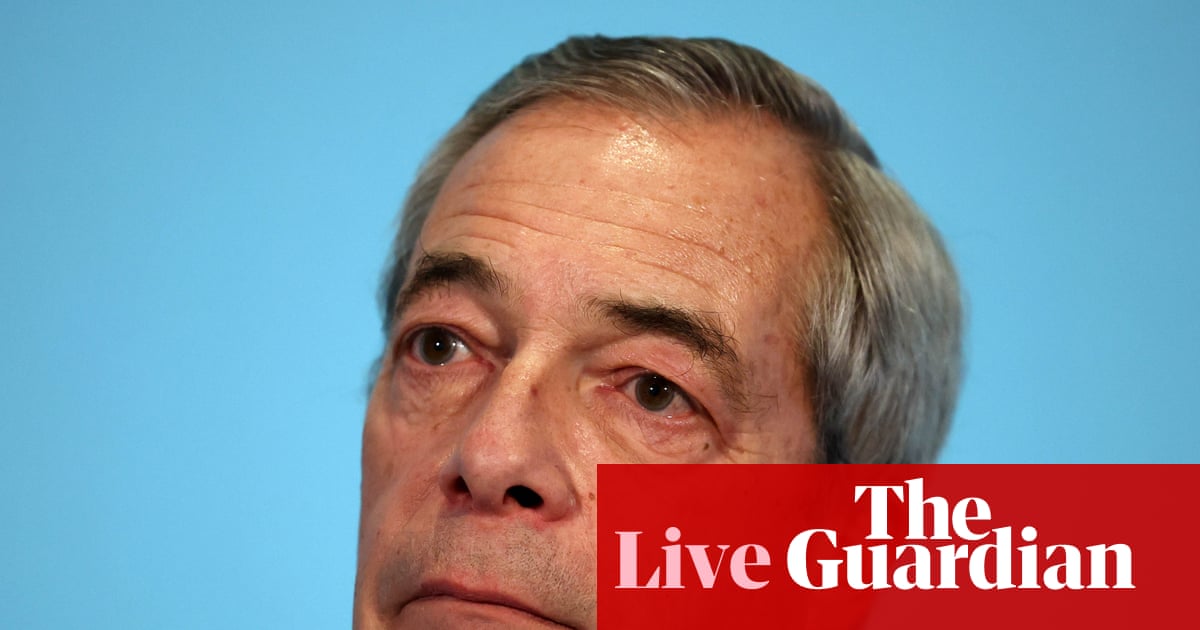
Nigel Farage, the Reform UK leader, was not in the Commons for PMQs today. He turned up at Time Radio at noon to do a PMQs-related broadcast instead.
In it, he restated his criticism of Keir Starmer’s Ukraine policy from his press conference (see 10.35am), but went a bit further – saying that he would vote against any proposal to deploy troops to Ukraine. He explained:
I would vote against [deploying troops to Ukraine]. We neither have the manpower nor the equipment to go into an operation that clearly has no ending timeline.
If it was a sort of Korean-style UN where lots of countries were involved and we could rotate in and out, I might consider it then.
But frankly, what you saw yesterday was [French president Emmanuel] Macron standing there with the British prime minister. Giorgia Meloni [the Italian PM] was outside having a cigarette, not getting involved. The German gave a speech and said nothing. The coalition of the willing is just two countries.
Frankly, what this would be is a modern-day British army of the Rhine. When we did that, defence was 5% of our national expenditure and we were there for 50 years.
Ben Quinn is a Guardian political correspondent.
A senior minister in Greenland’s government will come to London next week to appeal directly to British MPs for support in the face of Donald Trump’s threats to annex the semi-autonomous Danish region.
Naaja Nathanielsen, Greeland’s energy minister will travel to parliament on Tuesday and address an emergency meeting of MPs in Westminster Hall.
The invitation to her comes from Polar Research and Policy Initiative (PRPI), a think tank which administrates an all-party committee on Greenland.
Brendan O’Hara, the Scottish National Party MP who chairs the committee, said it would be an opportunity for British MPs and peers to hear directly from a member of the Greenlandic government at a time when a US invasion would be “catastrophic” for NATO. He told the Guardian:
If you look at what people like Trump and others in administration are saying we need to take that threat that they will carry it out seriously. It’s like Maya Angelou’s comment: “When someone shows you who they are, believe them the first time.”
The threat to Greenland comes as differences have opened up on the issue among British MPs. Nigel Farage, leader of the populist Reform UK party and an ally of Donald Trump, told a press conference on Wednesday that there was “a strong feeling” in British intelligence circles that there needed to be a significant Nato base located in northern Greenland. (See 10.41am.)
Nigel Farage, the Reform UK leader, was not in the Commons for PMQs today. He turned up at Time Radio at noon to do a PMQs-related broadcast instead.
In it, he restated his criticism of Keir Starmer’s Ukraine policy from his press conference (see 10.35am), but went a bit further – saying that he would vote against any proposal to deploy troops to Ukraine. He explained:
I would vote against [deploying troops to Ukraine]. We neither have the manpower nor the equipment to go into an operation that clearly has no ending timeline.
If it was a sort of Korean-style UN where lots of countries were involved and we could rotate in and out, I might consider it then.
But frankly, what you saw yesterday was [French president Emmanuel] Macron standing there with the British prime minister. Giorgia Meloni [the Italian PM] was outside having a cigarette, not getting involved. The German gave a speech and said nothing. The coalition of the willing is just two countries.
Frankly, what this would be is a modern-day British army of the Rhine. When we did that, defence was 5% of our national expenditure and we were there for 50 years.
Lord Wolfson, the shadow attorney general, will not be giving the shadow cabinet legal advice relating to Ukraine or Russia, the Tories said at their post-PMQs briefing.
Wolfson will recuse himself from these decisions because of the work he is doing with Roman Abramovich, the party said. This means he would not give advice relating to any decision to deploy troops to Ukraine.
A spokesperson for Badenoch said that this would not be a problem, because there was plenty of other legal expertise in the shadow cabinet, from people like Robert Jenrick, the shadow justice secretary, and that Badenoch was still pleased to have Wolfson in her team.
The announcement in effect confirms the argument that Keir Starmer made at PMQs about having Wolfson in the shadow cabinet amounting to a conflict of interest.
Referring to Wolfson, Starmer said:
How can someone sit in her shadow cabinet, advising someone trying to escape sanctions, and pretend that their policy is to support us on sanctions?
In reply, Badenoch said:
Do they know what the shadow attorney general is doing? He is defending veterans pro-bono against the actions of this government on this side of the House. We will defend those who defended us.
But why don’t we talk about the actual attorney general who is sitting in cabinet? The man who defended Gerry Adams, the man who is trying to bring Shamima Begum back into the country, the man who is helping to surrender the Chagos Islands.
I will take our shadow attorney general every day of the week against his attorney general.
And then Starmer replied:
Of course, I accept that lawyers have to represent all sorts of clients. The question is whether the shadow attorney general can sit in the shadow cabinet when the party opposite says it supports us on sanctions?
We want the money from Chelsea Football Club to go to Ukraine. I’m not sure whether that’s her position.
If it is her position, presumably it’s something they discuss in the shadow cabinet, advised by a shadow attorney general who is representing the very man whose money we want to send to Ukraine.
If she can’t see the conflict of interest in that, then she shows no judgment and no leadership at all.
On big foreign policy issues, the two main parties normally agree far more than they disagree. And at PMQs this tends to result in PM/opposition leader exchanges that are serious, sombre, consensual – and, for journalists, rather dull. This never used to happen very often, but when it did it was hard to avoid the conclusion that this arrangement suited both party leaders because it was easy for them to write the script, because they knew they would not have to spend hours and hours preparing combative material covering a range of subjects.
There are three, related foreign policy stories in play at the moment, and on all three Labour and Tory instincts are mostly aligned. On Ukraine, UK government policy did not really change at all when Labour took office and, in the unlikely event of Kemi Badenoch becoming PM tomorrow, it is hard to imagine her divering from the “Coalition of the Willing” strategy. On Greenland, both leaders are probably horrified by Donald Trump’s neo-imperial posturing, but also wise enough not to respond over-aggressively. (The UK is not an outlier on this; even though Ed Davey is calling for more blatant Trump-bashing, almost all the leaders in Europe who actually hold office are adopting a similar line to Starmer’s.) On Venezuela, Badenoch did strike a slightly different tone yesterday. But, even here, the gap between the two parties is relatively modest; No 10 was also positive about Nicolás Maduro being removed from office, and Badenoch’s support for Trump sounded qualified, not enthusiastic or unconditional.
In these circumstances, any other Conservative leaded would have gone for the soft-ball approach this afternoon, and rattled off six neutral, statesman-ish questions mostly about Ukraine.
But Badenoch could not do this because she seems congenitally incapable of not having a row with an opponent – even when she broadly agrees with them. In most circumstances, this appretite for conflict serves her well, but today it left her looking a bit irrelevant. Unable to disagree with Starmer on points of substance, she was reduced to focusing on process matters. She was right to say that, if Starmer really wanted to make his statement to MPs about Ukraine “at the earlier opportunity”, he could do it today. But who cares?
Then Badenoch started asking Starmer about his calls with Trump, and saying he should be convening an urgent meeting of Nato leaders (to discuss Greenland). Starmer was able to say (rightly) that he met a lot of Nato leaders in Paris yesterday, and he had made this point about a previous Nato meeting.
We had one of the strongest Nato meetings last year, the summit, where we had more members of Nato and more unity. When I arrived back to the House to make a statement, which of course she asked for, her position was, I shouldn’t have missed PMQs, I should have empty-chaired the Nato summit. That’s how serious she is about Nato.
Towards the end of the exchanges Badenoch and Starmer both resorted to partisan talking points. Badenoch raised the Northern Ireland Troubles bill, which is a niche cause for the rightwing media, but of very little interest to anyone else. Starmer had slightly stronger ammo when he criticised the shadow attorney general over his client list. It was not a heroic PMQs start to the new year for him, but it went better than his last few performances in 2025 and today he saw off Badenoch with ease.
Wendy Morton (Con) says green fields in her constituency are under threat. Does Starmer accept his housing targets can be met without green fields being sacrificed.
Starmer says the government will be able to achieve its goals without ripping up farmland.
And that’s the end of PMQs.
Angus MacDonald (Lib Dem) says the problem of young people emigrating is particular severe in the Scottish highlands. They have a demographic crisis. What is the goverment doing to address this?
Starmer says the UK government is providing record investment into apprenticeships. But the SNP government blocked a welding apprenticeship scheme on the Clyde because it was linked to defence, he says.
Fabian Hamilton (Lab) asks for an inquiry into maternity deaths at Leeds hospital.
Starmer says he wants this inquiry to start as soon as possible. A chair of the highest standard will be appointed, he says.
Alison Griffiths (Con) says a cargo vessel last year lost 16 containers off the Sussex coastline. The clean-up effort was led by volunteers, she says. She asks Starmer to pay tribute to them.
Starmer thanks the volunteers. He says liability for the cost of any clean-up lies with the polluter.
Davey also asked Starmer about Greenland. If Trump were to seize Greenland, that would be the end of Nato?
Starmer thanked Davey for raising this. He went on on:
The future of Greenland is for Greenland, for the Kingdom of Denmark and for Greenland and the Kingdom of Denmark alone.
I put out a statement to that effect, along with, fellow allies in Europe.
But of course, Nato is hugely important, the single most effective and important military alliance the world has ever known.
Starmer says Davey is trying to get him to choose between Europe and the US. “That would be a strategic mistake for our country,” he says.
Ed Davey, the Lib Dem leader, asks Starmer if he agrees with Geoffrey Robertson KC, head of his former chambers, who said that the US operation against Venezuela was illegal.
Starmer says he and “Geoffrey” have disagreed on many things over the years. He says Nicolás Maduro was not a legitimate leader.
Davey says it is “ridiculous” that Starmer cannot say whether or not he thought Trump broke international law.
Badenoch defends her shadow attorney general, David Wolfson. She says he is representing British veterans challenging Labour’s Northern Ireland legislation pro bono.
And she says she would take Wolfson any day over Lord Hermer, Labour’s attorney general, who had Gerry Adams as a client (before he became a minister).
Starmer says he accepts that lawyers work for clients whose views they do not support. But he says the Tories support sanctions against Russia over Ukraine. But Wolfson is on the other side, he suggests. He says Badenoch should be able to see the conflict of intereest.
Badenoch says Ben Wallace told the Today programme this morning that defence spending had fallen under both main parties. It was last at 3% under the Tories, she says.
She says Starmer sat in shadow cabinet under a leader who did not even support Nato.
She says SAS veterans have said the government’s Northern Ireland Troubles bill is a threat to the SAS.
Starmer says Badenoch’s reply is embarrassing. The Tories were in office for 14 years, he says. And he says Badenoch has a shadow attorney general who is working for Roman Abramovich.
And the Tories gave immunity to IRA terrorists with their Northern Ireland legislation, he says.
If Badenoch wants to bring this back, she should say so.
Badenoch says the deployment of British troops to Ukraine could lead to them being at war with Russia. She asks when the government will get defence spending up to 3% of GDP.
Starmer says he spoke to President Trump twice over the Christmas period about Ukaine. He says there is no gap between the UK and the US on the Ukraine plan.
On defence spending, he says the money for the increase is provided in the budget.
When the Tories were in power, the armed services were “hollowed out”, according to Ben Wallace, the former defence secretary, he says.
He says he is proposing to raise defence spending three years earlier than would have happened under the Tories’ unfunded promise.
Badenoch asks how many British troops might be deployed to Ukraine, and in what capacity.
Starmer says he was with Nato allies all day yesterday.
He says the Ukraine agreement was set out last night. He says British troops would go to Ukraine “to support Ukraine’s capabilities if it conducted deterrence operations and to construct and protect military hubs”. He says the number of troops being deployed would be set out at the time.
Badenoch says today is the earliest opportunity for Starmer to make a statement about Ukraine. She claims Starmer is “scared” to take questions on this.
She asks him if he will call for an urgent of meeting of Nato leaders to discuss Greenland.
Starmer says that in the past Badenoch criticised him for missing PMQs to attend an international meeting.
Kemi Badenoch welcomes “the prime minister’s efforts” to secure peace in Ukraine and in Greenland.
But she says it is “astonishing” that the statement to MPs on Ukraine won’t happen today.
She says he should have done, given the commitment to deploy troops.
She says, even though the US is the UK’s closest ally, the sovereignty of Greenland is sacrosanct. She asks what Starmer is doing to make that clear to Donald Trump.
Starmer says the agreement yesterday was a political declaration. Further steps would have to take place before a troop deployment.
He says he will make a statement to MPs at the earliest opportunity.
Starmer tells MPs about the Coalition of the Willing meeting yesterday, and says he will set the details out to MPs in a separate statement in due course.
If troops were to be committed on the ground, MPs would get a vote, he says.
Keir Starmer starts by saying he hopes all MPs had a happy Christmas. It probably feels like a long time ago, he says. But not for Reform UK – “because today is the day they celebrate Christmas in Russia”.
PMQs is about to start.
Here is the list of MPs with a question.