
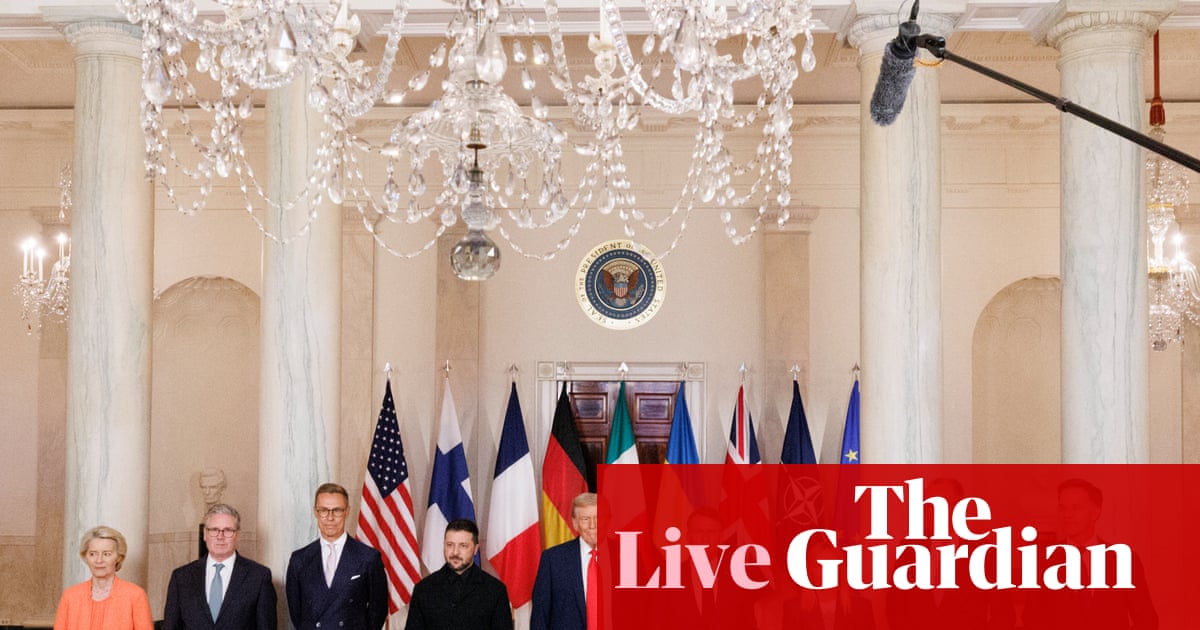
Ukrainian president Volodymyr Zelenskyy has said that Ukraine and Europe will soon be ready to present “the refined” peace plan to the US, taking into account recent discussions at the level of national security advisers.
In a social media post, he said the work continued “very actively on all components of potential steps toward ending the war.”
“The Ukrainian and European components are now more developed, and we are ready to present them to our partners in the US,” he said.
“Together with the American side, we expect to swiftly make the potential steps as doable as possible,” he said.
Zelenskyy stressed that Ukraine remained “committed to a real peace,” and that “everything depends on whether Russia is ready to take effective steps to stop the bloodshed and prevent the war from reigniting.”
“In the near future, we will be ready to send the refined documents to the United States,” he ended.
… and on that note, it’s a wrap for today!
-
Donald Trump has hinted he could walk away from supporting Ukraine as he doubled down on his administration’s recent criticism of Europe, describing it as “weak” and “decaying” and claiming it was “destroying itself” through immigration (12:36, 12:44,)
-
Trump also said that there was “no question” that Russia was in a stronger negotiating position in talks over ending the Ukraine war (13:11), saying Ukraine’s Zelenskyy will “have to get on the ball and start accepting things” (13:13).
-
Trump also pointedly criticised EU leaders to “taking too much,” but “not producing,” as “the war just keeps going on” (13:17).
-
His latest tirade – in an interview with Politico after named ‘the most powerful person shaping Europe’ – will make an already complicated relationship even more awkward (13:22).
-
Germany’s chancellor Friedrich Merz has criticised parts of US narrative in recent days, saying it was “unacceptable” from the European point of view (11:43), with the EU’s foreign policy chief Kaja Kallas (11:27, 11:53) and the European Council president António Costa (15:36) also expressing their frustration with the tone coming from Washington.
In other news,
-
71-year-old controversial billionaire and Trump fan Andrej Babiš has been appointed the next Czech prime minister, two months on from the parliamentary election in October (9:49, 10:14, 10:27, 10:31).
-
Ukrainian president Volodymyr Zelenskyy has continued his Europe tour meeting Pope Leo (10:53, 12:23) and Italy’s prime minister Giorgia Meloni (9:57, 14:46, 16:40, 17:05) as he seeks to consolidate the European support for Ukraine.
-
Lithuania has declared a state of emergency and asked parliament to authorise military support for police and border guards after a wave of smuggler balloons from Belarus repeatedly disrupted air traffic in recent months (13:57).
And that’s all from me, Jakub Krupa, for today.
If you have any tips, comments or suggestions, email me at [email protected].
I am also on Bluesky at @jakubkrupa.bsky.social and on X at @jakubkrupa.
Speaking after his meeting with Meloni, Zelenskyy said they had “an excellent and very substantive discussion” on the Ukraine war.
“We appreciate Italy’s active role in generating practical ideas and defining steps to bring peace closer,” he said.
Zelenskyy added he “briefed [Meloni] on the work of our negotiating team, and we are coordinating our diplomatic efforts.”
“We are counting greatly on Italy’s continued support – it matters for Ukraine,” he said.
And that Meloni/Zelenskyy meeting I mentioned earlier is now under way in Rome.
Here are some pictures from the welcome ceremony for the Ukrainian president.
Ukrainian president Volodymyr Zelenskyy has said that Ukraine and Europe will soon be ready to present “the refined” peace plan to the US, taking into account recent discussions at the level of national security advisers.
In a social media post, he said the work continued “very actively on all components of potential steps toward ending the war.”
“The Ukrainian and European components are now more developed, and we are ready to present them to our partners in the US,” he said.
“Together with the American side, we expect to swiftly make the potential steps as doable as possible,” he said.
Zelenskyy stressed that Ukraine remained “committed to a real peace,” and that “everything depends on whether Russia is ready to take effective steps to stop the bloodshed and prevent the war from reigniting.”
“In the near future, we will be ready to send the refined documents to the United States,” he ended.
Ireland’s Martin also picks up on the question about Trump’s comments and he says he disagrees with his description with Europe as “weak.”
“Obviously, it depends on how one defines strength. But Europe is one of the strongest continents in the world in terms of economic strength, and that’s manifested in the EU US trade agreement. Inherently in that agreement is a recognition of strength of Europe, economically.”
He also says Europe remains a big donor for conflict areas around the world and to various sustainability initiatives.
“So I look at it from a different perspective in terms of how one defines strength, and I think Europe is strong, not weak.”
He adds:
“Clearly, in the area of security, new challenges have arrived.
The onset of the brutal invasion of Ukraine by Russia has meant increased hybrid attacks across Europe, certainly in terms of greater vulnerabilities, and therefore Europe is now focusing on that in terms of meeting those security challenges.
And I’m confident that Europe has the capacity, has the economic scale to respond to those challenges.”
EU’s Costa gets also asked about Trump’s all-out criticism of Europe earlier today.
He says:
“We are allies with United States, and allies must act as allies. That means that we should not interfere in the political internal life of our countries. …
We respect the choice of Americans, and they need to respect the democratic choice of our citizens.”
He also picks up on the frozen assets, and says he thinks “we are very close to obtain solution” to this issue, resolving Belgium’s longstanding opposition to the proposals on the table.
Oh, that’s interesting.
Asked about the recent security incident at Dublin airport with drones approaching the airspace just as Volodymyr Zelenskyy was meant to land during his visit last week, Ireland’s Martin suggest it was not a coincidence that it happened just as the EU is discussing the issue of using frozen Russian assets to fund Ukraine.
He says:
“I think the drone incident does fit in, as Antonio has said, with an established pattern of similar disruption incidents that have taken place in other European states.
And one of my colleagues at recent meetings said, you know, accidents happen on an individual basis. Patterns can be discerned over a period of time, and that is what we are witnessing here, and indeed have witnessed across other EU member states in different forms.
But we need to be very clear about that. And of course, you know, we have some very serious issues on our agenda. As Antonio has said, the entire issue of the future financing of Ukraine, the utilisation of immobilised assets, which is a very big issue for Russia. And I don’t believe what’s happening is just coincidental, put it that way”
Over in Dublin, Irish prime minister Micheál Martin is now speaking at a press conference alongside the European Council’s president, António Costa.
He talks about “the need to continue and step up our support for Ukraine, political, military and financial,” as the talks continue with hopes of securing “a just and lasting peace as soon as possible.”
He blames Russia for continuing attacks on Ukraine and the recent violation of EU airspace, calling them “reckless” and “threatening European security and regional stability.” “Threat from Russia is real and impacts all EU member states,” he says.
Martin also pointedly speaks about the need to “increase pressure on Russia until it ends its injustifiable war,” calling for urgent agreement on further financing for Ukraine, including the use of immobilised Russian assets.
He also clearly backs Ukraine’s ambitions to join the EU, which is important in the context of Ireland’s upcoming EU presidency in the second half of 2026.
Responding, Costa picks up on that theme as he says that Ireland is seen “as a pro European country and an honest broker, and that will be very useful for the success of your presidency.”
But he says that “at a time of rising global tensions, it’s never been more crucial to guarantee Europe’s security,” stressing the bloc continues “working on all fronts to stop Russia’s war of aggression.”
Costa also talks about the importance of next week’s European Council summit expected to discuss further support for Ukraine.
“Europe will remain Ukraine’s strongest and most reliable partner, and this is what the European Council will deliver next week,” he says.
in Rome
We are expecting Ukraine’s Zelenskyy to meet with Italy’s Giorgia Meloni shortly, one of the European leaders that seem to still be in Trump’s good books.
Meloni will endeavour to balance her loyalties between the EU and Washington, and while Italy is preparing aid to bolster Ukraine’s energy network, she may urge Zelenskyy to accept territorial concessions to end the war, according to reports in the Italian press. Italy has also so far deemed it risky to use frozen Russian assets to fund reconstruction in Ukraine.
Writing in Corriere della Sera, Massimo Franco said the Italian government will strive to avoid appearing to be an outsider in the peace talks after its absence in London, while asserting its autonomy.
Meanwhile, Lithuania has declared a state of emergency and asked parliament to authorise military support for police and border guards after a wave of smuggler balloons from Belarus repeatedly disrupted air traffic in recent months, Reuters reported.
Vilnius airport has been closed several times due to the weather balloons, which Lithuania says are sent by smugglers transporting cigarettes and constitute a “hybrid attack” by Belarus, a close ally of Russia.
“The state of emergency is announced not only due to civil aviation disruptions but also due to interests of national security,” interior minister Vladislav Kondratovič told a government meeting.
The Lithuanian government asked parliament to grant the military powers to act in concert with police, border guards and security forces during the state of emergency, as well as on its own, Kondratovic said.
The emergency measures will last until the government calls them off.
Belarus has denied responsibility for the balloons and accused Lithuania of provocations, including sending a drone to drop “extremist material“, which Lithuania denies, Reuters noted.